XT30, XT60, and XT90
What people call it
XT connectors, battery connectors, LiPo connectors, "the yellow ones."
What it actually is
A keyed, polarized DC power connector ecosystem commonly sold under XT30 / XT60 / XT90 names in RC and hobby battery wiring — solder-cup bullet-style contacts in a keyed nylon shell, sized XT30 → XT60 → XT90. (Holding something that isn't an XT? The RC battery connector landscape identifies the rest — Deans, EC, Traxxas, Tamiya-style, bullets, Powerpole.) The originator is Changzhou Amass Electronics (AMASS), which states on its manufacturer site that it is "the original creator of the XT series."1 Marketplace parts may be genuine AMASS or clones of unknown quality — the ratings below describe genuine AMASS parts only.
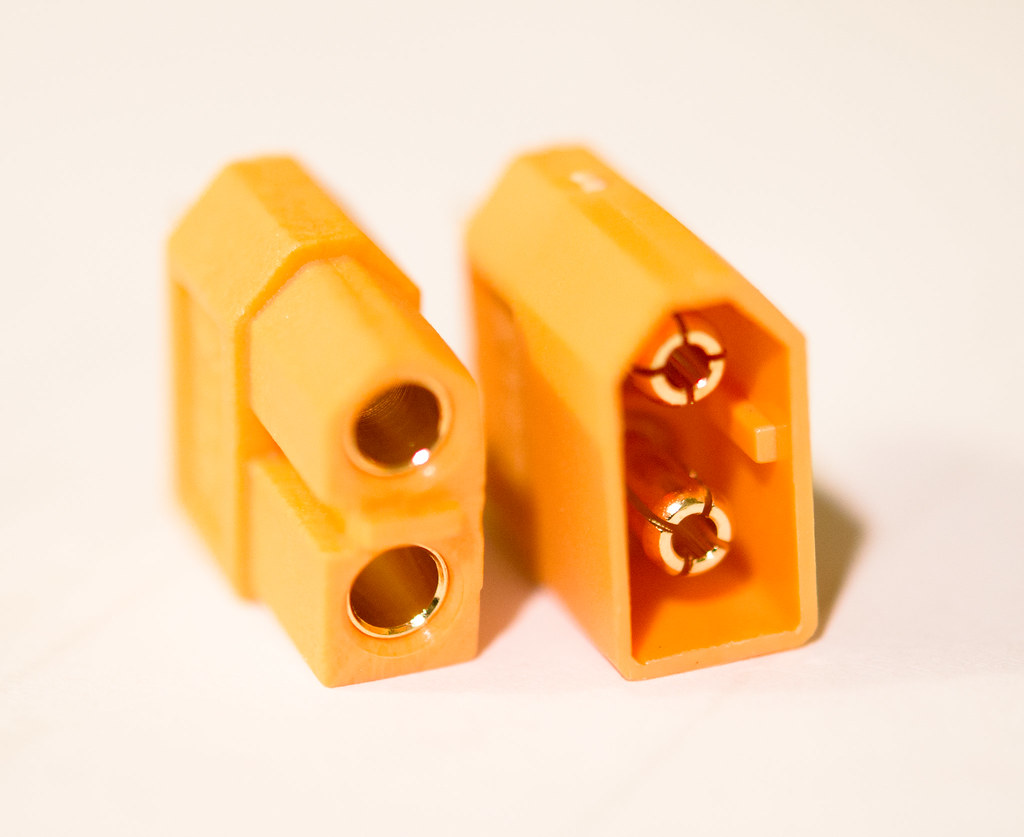
An XT60 pair, mating ends: keyed yellow nylon shell, two bullet contacts. Photo: qvfp, CC BY 2.0, via Flickr.
The sourced ratings — and the trap in the name
Per AMASS's own documentation, the digits in the name are the momentary current, not the continuous rating. Continuous ("rated") current is half or less:
| Family | Rated (continuous) current | Momentary current | Recommended cable |
|---|---|---|---|
| XT30 (XT30U) | 15 A2 | 30 A2 | 18 AWG2 |
| XT60 (incl. U/H/L variants) | 30 A23 | 60 A2 | 12 AWG2 |
| XT90 (XT90H; XT90S anti-spark) | 40 A2 | 90 A2 | 10 AWG2 |
All per the same AMASS documentation: DC 500 V, gold-plated brass contacts, PA UL94 V0 housings, 1000 mating cycles, −20 °C to +120 °C.2 Conditions matter enormously: AMASS's XT60E sheet shows the same connector at the same 30 A rising 27.8 °C above ambient with 12 AWG wire but 85 °C with 14 AWG3 — the wire is part of the rating. These are genuine-part figures under AMASS's test conditions, not clone promises and not your application's derating.
Where it shows up
Battery packs, RC vehicles and drones, portable power, hobby robots, bench power leads, e-bike-adjacent DIY (where the stakes rise fast — see below).
How to identify it
Keyed trapezoid-ish shell with two (or, in XT90 anti-spark variants, resistor-equipped) bullet contacts; size steps visibly between the three. Clones are everywhere; contact plating, shell material, and fit vary with them.

ID marks: keyed shell (can't reverse), two bullets, three visible size steps — and the digits-are-momentary trap.
What to buy
Matched male/female pairs from a supplier you can name, sized from calculated current, plus quality heat-shrink. Soldering is the termination: tin the cup, tin the wire, one clean joint, insulate — a cold joint or wicked-stiff wire at the exit is the standard failure. Strain relief and no exposed metal are part of the job (crimping-page discipline applies in spirit, soldered edition).
XT-class connectors are useful for hobby DC power, but they are not automatically sealed, touch-safe, load-break rated, or safe to unplug under load. Size them from calculated current, wire gauge, genuine/source-backed ratings, fusing, and service conditions.
Common traps
- Sizing by digits. "60 means 60 A continuous" is exactly wrong — per AMASS, 60 is the momentary figure and 30 A is the continuous rating.2 Size from the calculation and the table above (genuine parts) or your actual part's documentation.
- Undersized wire. The temperature-rise data above shows the wire gauge changing the thermal outcome threefold at identical current.3
- Clone roulette — a loose clone-to-genuine mate heats at exactly the moment of max current, and the AMASS figures don't transfer.
- Unplugging under load — battery DC arcs; plan a switch/de-energize step, and consider the XT90S anti-spark variant for high-capacity packs (verify the exact part's provision).
- No fuse. A battery can deliver enormous fault current; fuse near the source (power vs signal).
- Exposed energized contacts on the live half — male pins on the battery side are a short circuit waiting for a wrench.
Source status
Attribution and ratings are sourced: the originator claim from AMASS's manufacturer site,1 and the ratings from AMASS-authored documentation — the product catalog and an XT60E spec sheet, both manufacturer-authored PDFs hosted by distributors/resellers (AMASS's own site publishes no spec tables; its catalog is available on request). Figures apply to genuine AMASS parts under AMASS's stated conditions; clones are not covered, and AMASS notes its data sheets "will change according with the test background."3 Tracked in Hobby Source Notes.
When to move to the engineering track
Higher-energy packs, fielded systems, or anything where the energized-connector questions (load-break, touch safety, fault current, inrush) need documented answers — go straight to the high-current DC path and its safety warning, and When Hobby Connectors Are Not Enough. For sealed vehicle/field wiring one step up, see rugged on a budget and the DEUTSCH deep dive.