JST-XH
What people call it
XH, "JST 2.5," balance connector, balance lead, "JST 2.54" (wrongly), printer connector.
What it actually is
The genuine JST XH series: 2.5 mm-pitch wire-to-board family — board header plus wire housing with XH-specific crimp contacts — rated in the 3 A class per the official JST datasheet.1 Marketplace "XH" may be genuine JST, a decent clone, or a loose lookalike; the figures here describe genuine parts.
Where it shows up
3D printers (endstops, thermistors, fans, steppers on many budget boards), LiPo balance leads, and low-cost wire-to-board harnesses across budget electronics.
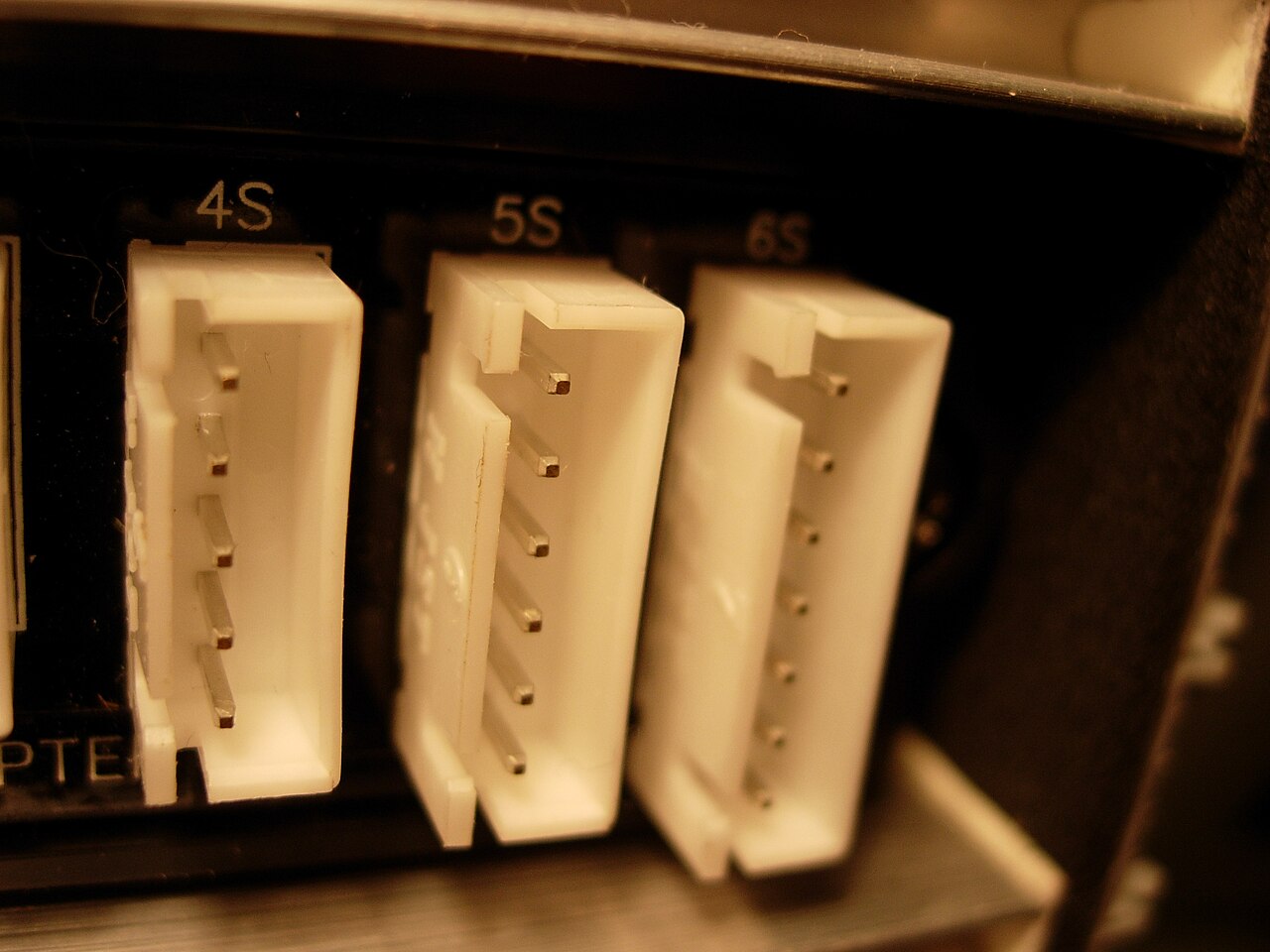
The XH you probably know: balance ports on a LiPo charger. Photo: Laurenz Wagner, CC BY 3.0, via Wikimedia Commons.
XH in detail — the datasheet numbers
Because this is probably the JST series you actually own, the official-datasheet detail is worth having at hand:1
| Spec | Value | What it means in practice |
|---|---|---|
| Pitch | 2.5 mm | Not 2.54 — the whole trap in one row |
| Positions | up to 20, single row | From 2-pin fans to long balance/harness runs |
| Rating | 3 A AC/DC max, 250 V | The 3 A is the top of the range — gauge- and contact-dependent |
| Contacts | SXH-001T-P0.6 (#28–22 AWG) · SXH-002T-P0.6 (#30–26 AWG) | Two crimp contacts for two wire ranges — the 3 A headline belongs to the heavy-gauge end |
| Headers | top-entry and side-entry, shrouded | The boxy open-top shroud is the ID mark; both orientations are ordinary catalog parts |
| Retention | friction shroud, no latch arm | Repeatable, serviceable — and vibration protection is on you |
The row that changes real decisions is contacts: "an XH is 3 A" is only true with the right contact on the right wire. A #30 AWG lead in an XH housing is a signal lead wearing a power family's name — the contact-matches-the-wire principle at 2.5 mm scale.
The balance-lead convention, decoded
XH's most famous job is the LiPo balance lead, and the convention is worth writing down precisely because no battery standard governs it — charger and battery vendors document it as the de-facto "JST-XH balance" arrangement their balance boards assume:2
- Pin count = cell count + 1. A 3S pack has a 4-position plug, a 4S pack a 5-position plug, and chargers ship 2S–6S XH balance boards on exactly that pattern.
- One end is pack negative; the rest are ascending cell taps — B−, cell 1, cell 2, … up to pack positive at the far end, so the charger can read every cell across adjacent pins.
- It's a convention, not a spec. Before a pack's first charge — and before trusting any adapter or extension — verify the tap order with a meter against the charger's documentation. A miswired balance lead puts full-cell voltages across the wrong charger inputs, and lithium chemistry grades that mistake harshly.
Balance taps carry balancing currents; the pack's main current stays on a real power connector. And the fact that the plug is "just an XH" is exactly why buying genuine parts matters here — the one connector in the hobby that routinely touches every cell of a lithium pack is a bad place for a mystery-metal clone.
How to identify it
2.5 mm pitch (measure across the row — this is the classic 2.5-vs-2.54 trap), friction-lock shroud on the header (no positive latch arm like GH), white nylon housing. Distinguish from PH (2.0 mm, smaller), VH (3.96 mm, much larger power family), EH (also 2.5 mm but a different, slimmer family — check the drawing), and generic "JST 2.54" kit parts (a contradiction — see the kit decoder).

ID marks: 2.5 mm pitch, boxy open-top shroud, friction fit — no latch arm.
What to buy
Housing + XH contacts (separate line items) + the board header, or pre-crimped XH leads from a reputable supplier. Genuine JST from an authorized distributor costs pennies more than mystery parts — see Buying the Right Mating Parts. Contacts are XH-specific: not PH, not EH, not kit-drawer "Dupont."
Common traps
- Balance-lead assumptions. The balance-connector convention makes XH common on packs — it does not make every XH harness appropriate for every battery use. Balance leads carry small balancing currents; main pack current belongs on a real power connector.
- Polarity/pinout is per the board, not the connector. Printer boards and battery pigtails differ vendor-to-vendor — verify against the silkscreen/documentation before powering.
- 2.5 ≠ 2.54. An XH housing forced onto a 0.1 in header binds and mis-seats; it will "work" until it doesn't.
- It is not sealed or rugged. Indoor, protected, low-vibration use — no wire seals, no positive latch.
Source status
Pitch, position span, header orientations, the two crimp-contact wire ranges, and the 3 A / 250 V ratings are sourced to the official JST XH datasheet;1 the balance-lead arrangement is cited to charger-ecosystem vendor documentation and labeled as the convention it is — no battery standard governs it, so the meter check stands.2 Genuine-part figures don't transfer to clones, and application current still depends on contact, wire gauge, and temperature — verify the exact datasheet. See Hobby Source Notes.
When to move to the engineering track
Vibration, field exposure, real battery current, or someone else building the harness — see When Hobby Connectors Are Not Enough and, for sealed field wiring one step up, rugged on a budget (family detail in the DEUTSCH deep dive).