JST-SH, Qwiic, and STEMMA QT
What people call it
SH, "1 mm JST," Qwiic cable, STEMMA QT cable, "the little I2C connector."
What it actually is
Two things stacked: the genuine JST SH series — 1.0 mm-pitch crimp wire-to-board family, 1.0 A AC/DC (AWG #28) / 50 V per the official JST datasheet1 — and the vendor ecosystems built on it. Qwiic (SparkFun) and STEMMA QT (Adafruit) are ecosystem conventions, not just "any 4-pin JST": both standardize a 4-pin 1.0 mm JST SH connector (SparkFun cites the SHR-04V-S-class housing) with a fixed I2C pinout, and the two are cross-compatible by design.23
Where it shows up
Tiny I2C sensor/driver boards, solder-free sensor chains on dev boards, and increasingly as the standard "just works" I2C port on hobby electronics.
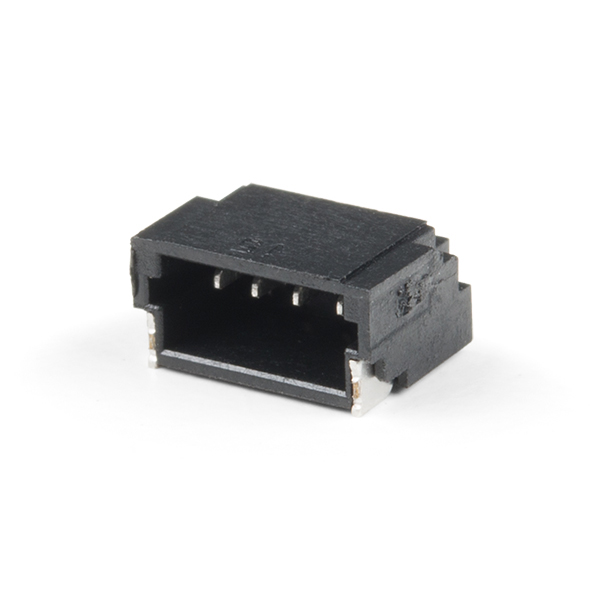
A 4-pin SMD JST SH — the Qwiic/STEMMA QT port itself. Photo: SparkFun Electronics, CC BY 2.0, via Wikimedia Commons.
How to identify it
1.0 mm pitch — genuinely tiny; distinguish from GH (1.25 mm, has a positive latch arm; SH is friction-fit) and from Molex PicoBlade-style 1.25 mm lookalikes. Four positions + the ecosystem branding usually means Qwiic/STEMMA QT. Grove (Seeed) is a different ecosystem on its own larger 4-pin 2.0 mm connector — and, unlike Qwiic/STEMMA QT's single fixed I2C convention, Grove's pinout varies by port type: the two signal pins carry SCL/SDA on an I2C port, RX/TX on a UART port, and D0/D1 or A0/A1 on digital/analog ports, with power and ground fixed on the other two.4 A cable moved between ecosystems — or between the wrong Grove port types — puts signals where the board doesn't expect them; verify the vendor pinout and connector documentation before mixing.

ID marks: 1.0 mm pitch, side-entry SMD, friction fit — note the true-size bar.
Plain STEMMA is not STEMMA QT
Adafruit runs two connector conventions with confusingly similar names, and they sit exactly on this guide's favorite trap — the 2.0 mm vs 1.0 mm pitch split. Plain STEMMA uses the larger JST PH (2.0 mm): 4-pin PH for I2C and 3-pin PH for analog/digital/PWM signals. STEMMA QT is the smaller JST SH (1.0 mm) 4-pin I2C convention this page is mostly about, created for boards where the larger PH connector won't fit.5 Both conventions specify 3–5 V device power, and Adafruit's 3-pin STEMMA ports add a protection circuit for 3.3 V controllers5 — but a PH cable will never mate an SH port, so measure the pitch first and trust the name second. Plain STEMMA's connector is the same JST PH covered on its own page.
What to buy
Pre-made cables, full stop. SH contacts are the hardest common hobby crimp there is (crimping); Qwiic/STEMMA QT cables from the ecosystem vendors exist precisely so you never crimp one. Buy spares in the lengths you need.
Common traps
- Power through the sensor chain. These are signal-level connectors on 3.3 V I2C ecosystems2 — do not pull meaningful power through them unless the ecosystem/part documentation explicitly supports the current (power vs signal).
- Pinout by assumption. The ecosystems define a fixed pinout — take it from the SparkFun/Adafruit documentation,23 not from wire colors on a third-party cable.
- "Any 4-pin 1 mm JST will do." A bare SH pigtail is not automatically wired to the Qwiic/STEMMA QT convention.
- Fragility — the housings and cables are small; strain relief is your problem.
Source status
SH series figures: official JST datasheet.1 Qwiic/STEMMA QT conventions: the vendors' own documentation.23 Grove connector facts are sourced to Seeed's documentation (see the Grove section above). See Hobby Source Notes.
When to move to the engineering track
When the "sensor chain" becomes a fielded instrument: vibration, sealing, or documented harnesses — When Hobby Connectors Are Not Enough and the industrial sensor path (where M8/M12 do this job with threads and seals).