Dupont / 0.1 Inch Headers
What people call it
"Dupont," jumper wires, breadboard wires, "2.54 mm connectors," male/female jumpers, GPIO jumpers.
What it actually is
The generic 0.1 inch (2.54 mm) pin-header ecosystem: square 0.025 in posts, friction-fit crimp sockets, and snap-together plastic housings in single and multi-position formats. "Dupont" is a hobby/marketplace folk name — a historical company reference, not a current manufacturer specification — so no drawing governs what a kit sells you, and housing/contact quality varies kit to kit.
The name does have a real ancestor: Berg's Mini-PV crimp system, an early 0.1 in design of exactly this type. Berg spent years as a DuPont division — which is where the nickname comes from — then passed through FCI to Amphenol, which still produces MiniPV® as a current 2.54 mm crimp family.12 Marketplace "Dupont" kits are generic imitations of that system, not the genuine line.
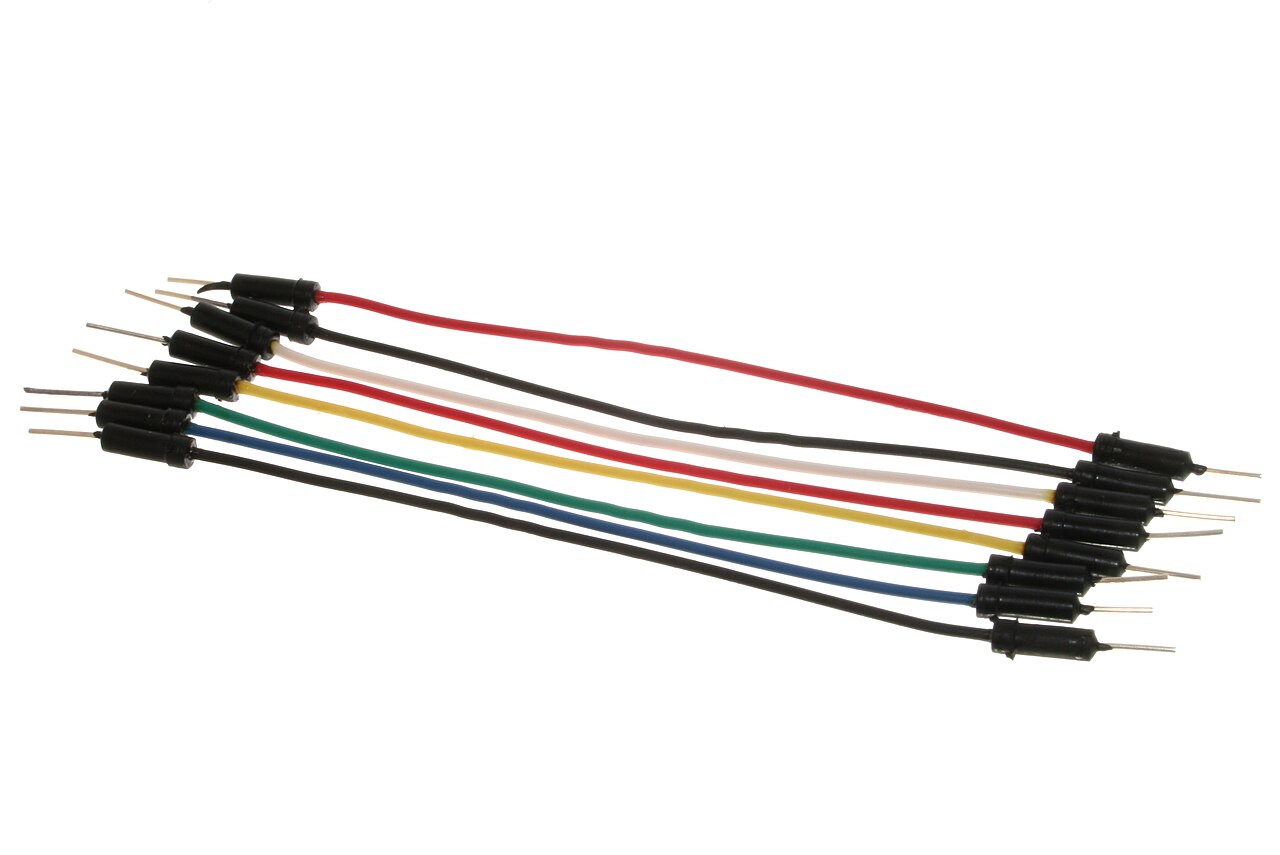
The bench classic: crimped pins in single-position friction housings. Photo: oomlout, CC BY-SA 2.0, via Wikimedia Commons.
Where it shows up
Breadboards, Arduino-style headers, Raspberry Pi GPIO jumper wiring, dev-board experiments, bench prototypes, test leads — anywhere speed of rewiring beats permanence. Its most famous descendant interface is the three-pin servo lead, which carries enough conventions and traps of its own to earn a dedicated page.
How to identify it
2.54 mm pitch (measure it — 2.5 mm lookalikes exist), square pins, rectangular black housings with removable crimp contacts. Female socket jumpers slide over pins; male pin jumpers plug into breadboards/sockets. Single housings carry one contact and can be re-shuffled freely; multi-position housings (1×N, 2×N) gang contacts but only fit matching header layouts — contacts can usually be extracted and re-housed.

ID marks: 2.54 mm pitch, square posts, friction-only retention — no latch, no polarization.
What to buy
For bench use: pre-made jumper assortments (M-M, M-F, F-F) from a reputable supplier beat crimping your own. For semi-permanent internal wiring, step up to a latched family instead — the classic destination is Molex Micro-Fit 3.0, and the internal PCB harnessing path maps the alternatives. If you do crimp: housings and contacts are separate purchases, and the crimping rules apply.
Dupont-style jumpers are excellent for breadboards and quick experiments. They have little retention, little polarization, no sealing, and inconsistent kit quality. Do not rely on them where vibration, high current, repeated service, or other people's hands are involved.
Common traps
- Power through jumpers. Thin kit wire plus a friction contact is a voltage-drop and heat generator — treat Dupont as a signal-and-milliamps connector and use real power wiring for anything that works for a living.
- No polarization — nothing stops a reversed or offset connection except your attention. Shrouded/keyed headers exist for a reason (glossary).
- Vibration walks them off. The first bumpy ride disconnects them; there is no latch.
- Kit-to-kit inconsistency — retention force and plating vary; a loose contact is an intermittent, not a failure you'll find quickly.
Source status
The name's lineage is sourced: Berg's Mini-PV as the ancestor and the Berg → DuPont → FCI → Amphenol chain per a community connector-history reference (attribution only — no ratings drawn from it),1 and MiniPV® as a current Amphenol 2.54 mm crimp family per Amphenol's own FCI Basics portfolio document.2 Beyond that, no governing manufacturer drawing exists for the generic ecosystem — that's the point of this page. Pitch (0.1 in = 2.54 mm) is definitional; everything else (current, retention, plating) is per the actual kit or the genuine header family you substitute. See Hobby Source Notes.
When to move to the engineering track
The moment the wiring leaves the bench: vibration, current, outdoor exposure, or someone else servicing it. Start with When Hobby Connectors Are Not Enough and the internal PCB harnessing path for latched, specified replacements.