Barrel Jacks and Polarity Traps
The barrel jack is the most-plugged, least-specified connector on your bench. Every wall adapter, router, guitar pedal, LED strip kit, and dev board uses one, and almost none of them tell you the three things that actually define the interface: two diameters, a polarity, and a rating. There is no single governing standard for "the barrel jack" — it's a family of coaxial DC power connectors where the numbers are everything.
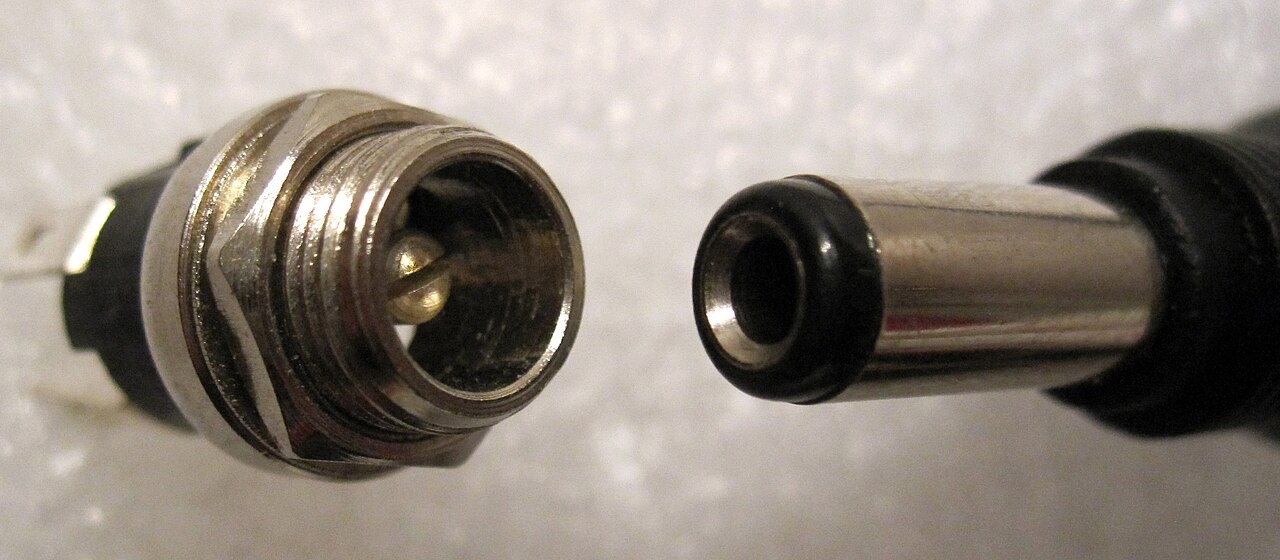
A 5.5 × 2.5 mm pair face to face — coaxial plug (outer sleeve + inner socket) meeting the jack's center pin. Every dimension here has a number, and the label rarely tells you any of them. Photo: Martin Meise, CC BY-SA 3.0, via Wikimedia Commons.
1. The size system: two diameters, both mandatory
A barrel size is a pair: the plug's outer sleeve diameter (OD) and its inner socket diameter (ID), which must swallow the jack's center pin. "5.5 mm barrel" is half an identification. The pairs you'll actually meet:
| Size (OD × ID) | Where you meet it |
|---|---|
| 5.5 × 2.1 mm | The hobby/router/CCTV default; most 9–12 V wall adapters |
| 5.5 × 2.5 mm | The same shell with a fatter pin — chargers, higher-current adapters, some SBCs |
| 4.75 × 1.7 mm / 4.0 × 1.7 mm | Small electronics, older laptops, some Pi-era supplies |
| 3.5 × 1.35 mm | Compact devices, USB-to-barrel leads |
| 2.35 × 0.7 mm class | Tiny portable gear |
| EIAJ classes | Japan's EIAJ RC-5320A defines a family of plug sizes tied to voltage classes (the yellow-insulator tips you see on some equipment) — a rare attempt to make size mean something |
Measure both numbers with calipers — the same discipline as pitch. The nastiest pair is 2.1 vs 2.5: a 2.1 mm plug slides into a 2.5 mm-pin jack loosely and sort-of works — intermittently, with heating and brownouts under load — while a 2.5 mm plug simply won't enter a 2.1 mm jack. "It fits" is not identification.
2. The polarity symbol — decode it, then meter it anyway
That little glyph on the wall adapter is the whole polarity contract:

The center dot is the pin, the outer arc is the sleeve; whichever one connects to “+” is the live one. Left: center-positive (the common convention). Right: center-negative (the guitar-pedal world). The symbol is the contract — the meter is the proof.
Center-positive is the common convention — but it is only a convention: Same Sky's own selection guide states plainly that reversing the assignment is acceptable practice,1 and one large ecosystem (9 V guitar pedals) standardized on center-negative. Two identical-looking 5.5 × 2.1 adapters can be electrical opposites. Before a barrel plug ever touches a device you care about: decode the symbol on both the adapter and the device, then verify with a meter — labels lie less often than clones, but the meter never does.
3. Anatomy details nobody reads
- The jack's third leg is a switch. Most panel/PCB jacks have a normally-closed switched contact that opens when a plug is inserted — it exists to disconnect an internal battery when external power arrives. If your device dies on wall power, someone probably ignored pin 3. Check the datasheet's schematic, not just the footprint.1
- The recessed contact is the safety feature. One conductor exposed, one recessed — that geometry is why a live barrel plug is hard to short with a keychain.1
- Pin diameter ≠ plug ID exactly. A "2.1 mm" system uses a nominal 2.0 mm jack pin inside a 2.1 mm plug socket — the class name and the drawing dimension differ, which is why you verify against the datasheet drawing, not the marketing size.2
- Locking variants exist (threaded-collar and snap types) — the answer to "the robot unplugged itself," short of graduating families entirely.
- Length matters too. Plug barrel lengths vary; a too-short plug on a deeply recessed jack mates on hope.
4. Ratings: per part number, never per "size"
There is no such thing as "a 5.5 × 2.1 is good for X amps." Current and voltage are rated per part, by the manufacturer, and they're often lower than folklore assumes: Same Sky's PJ-102A — as mainstream as a 5.5 × 2.1-class jack gets — is rated 2.5 A per its own datasheet.2 Marketplace listings routinely wave "5 A" at the same geometry with nothing behind it. The same skepticism the kit decoder teaches applies: the rating lives on the datasheet of the exact jack and plug you bought, and both halves plus the wire must carry the load. For real current, stop stretching barrels — see power vs signal and the RC battery landscape.
5. Traps
- Reversed polarity kills quietly. Protection diodes are not guaranteed in hobby gear. Symbol → meter → then plug.
- The 2.1-in-2.5 loose mate — intermittent power that "works when you wiggle it," heating at the pin under load.
- Same plug, different voltage. The connector does not encode voltage (EIAJ's size-per-voltage-class scheme being the exception that proves it1). A 19 V laptop brick fits the same jack as your 5 V device.
- Adapter current ≠ connector rating. A 10 A supply behind a 2.5 A-rated jack is a heating experiment at the tip.
- Worn tips. Barrel jacks are friction contacts with finite cycles (rated per datasheet); an old, loose mate is high resistance right where the power comes in.
- No strain relief. The solder joints on a PCB jack are not a cable anchor — anchor the cord, or use a panel jack.
6. When a barrel jack is enough — and when it isn't
Enough: bench gear, wall-powered projects that live indoors, anything where a pulled plug is an inconvenience. Not enough: vibration, outdoor exposure, real current, or a plug-cycle-heavy service point — graduate to a locking/keyed power family (XT-class, Powerpole) or, leaving the bench entirely, When Hobby Connectors Are Not Enough and the budget path.
Source status
Structure, polarity-convention, and switched/recessed-contact claims are cited to Same Sky's (formerly CUI Devices) own selection guide;1 the representative rating to the Same Sky PJ-102A datasheet.2 Size-pair identification is measurement-level; EIAJ RC-5320A is named as the standard defining size-per-voltage classes without reproducing its tables. Per-class EIAJ figures and any additional per-part ratings remain verify-per-datasheet; tracked in Hobby Source Notes.