DEUTSCH Deep Dive
If you spend any time around off-road equipment, farm machinery, trucks, marine wiring, or field robots, you'll run into DEUTSCH. TE Connectivity owns the brand now, but the reason people keep reaching for it hasn't changed: sealed housings, rear-release crimp contacts, real secondary locks, and all the seals, plugs, boots, and tools needed to build the thing properly. Small teams can actually afford and hand-tool it, too. For most readers here, DEUTSCH is the first serious step above hobby connectors and the last stop before mil circulars.
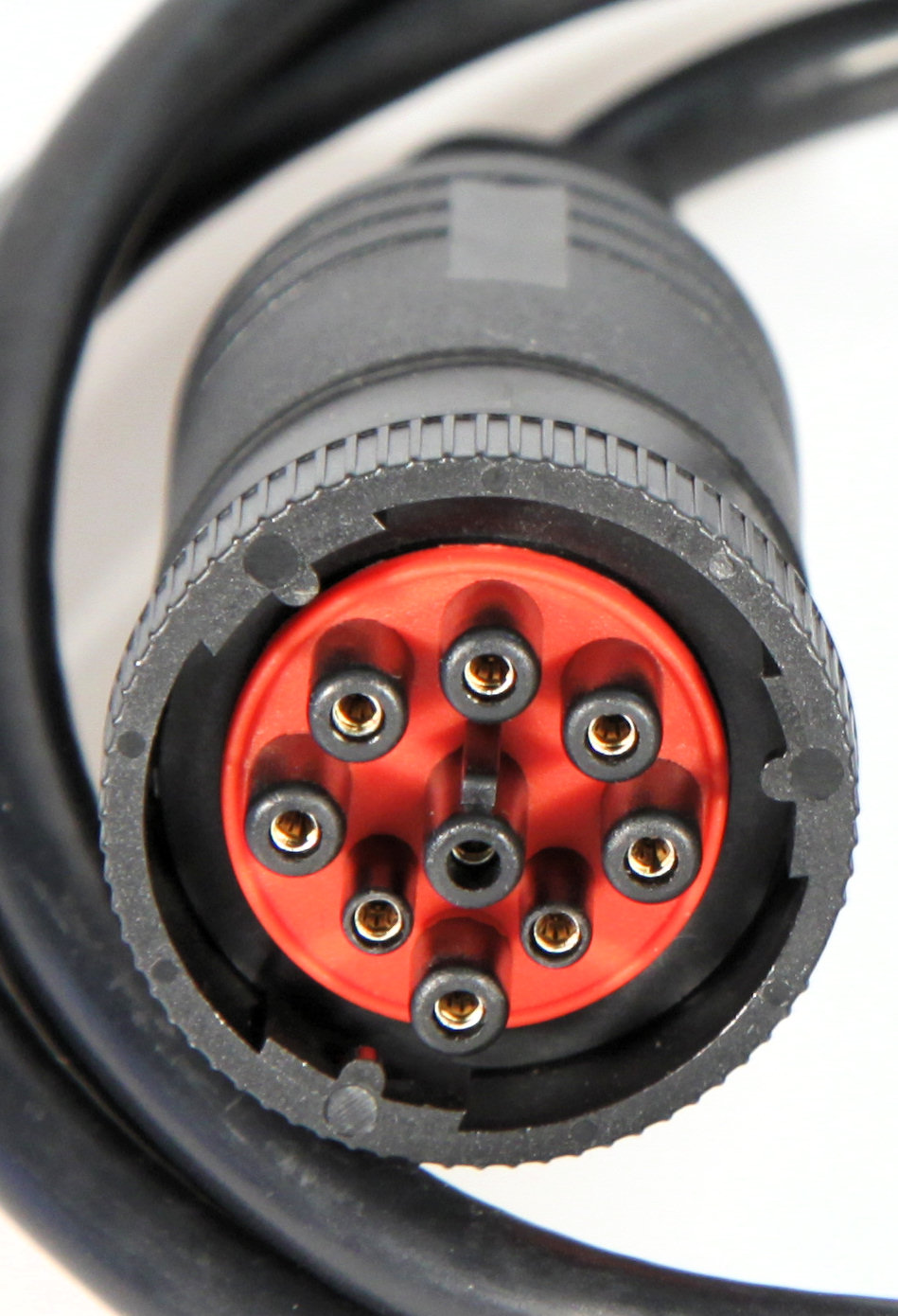
The sealed-DEUTSCH look on a real vehicle: an HD10-family 9-pin J1939 diagnostic plug — crimp contacts, wire seals, thumb-coupled shell. Photo: Florian Schäffer, CC BY-SA 3.0, via Wikimedia Commons.
If you just need to make a choice, start with Rugged on a budget. DEUTSCH and similar sealed automotive families are the main candidates there. Come back here when you want the details.
This is a supplemental deep dive, like the MIL-DTL-26482 page, not one of the numbered core sections. It goes well past the family table in Standards and Families (§3.2), but the rule stays the same: every number here is a cited, family-level orientation value. Your exact part's datasheet still wins.
1. What a full DEUTSCH interface includes
Plug housing + receptacle housing + contacts for both halves (pins and sockets, in the correct contact line) + wedgelock for each half + sealing plugs for every unused cavity + boot or backshell where the cable needs strain relief + pinout drawing + the correct crimp tool with an inspection criterion.
None of that is optional. Wire-to-wire DEUTSCH housings generally ship as bare shells: contacts, wedgelocks, and sealing plugs are separate line items, and the sealing claim assumes all of them are present and correctly installed. A DT missing its wedgelock will pass a bench tug-test and then back its contacts out on a vehicle; an unused cavity without a sealing plug is an open hole in a "sealed" connector.
2. The family map — every series and size
The industrial DEUTSCH range is basically one contact philosophy — rear-insert, rear-release crimp contacts behind silicone seals — packaged in different sizes and shapes. The figures below are cited family-level guides. For an actual shell, pull the series datasheet.123456
| Series | Format | Cavities / shells | Contact sizes | Continuous current class | Typical role |
|---|---|---|---|---|---|
| DTM | Rectangular wedgelock, wire-to-wire + flange/PCB | 2, 3, 4, 6, 8, 12 | 20 | ~7.5 A | Sensor and small-signal harnessing |
| DT | Rectangular wedgelock, wire-to-wire + flange/PCB | 2, 3, 4, 6, 8, 12 | 16 | ~13 A | The general-purpose default |
| DTP | Rectangular wedgelock | 2, 4 | 12 | ~25 A | Power distribution branches |
| DTHD | Single-cavity heavy-duty | 1 | 12 / 8 / 4 | ~25 / 60 / 100 A | Battery, starter, charge lines |
| HD10 | Compact thermoplastic circular | 3–9 | 12 or 16 (incl. 16+4 combos) | ~13 A (size 16) | Legacy vehicle I/O; the J1939 9-pin diagnostic |
| HD30 | Heavy-duty circular, metal shell, quarter-turn coupling | Shell sizes 18 & 24; arrangements from 2 to 47 cavities | 4–20 | ~7.5–100 A | Heavy-equipment trunk harnesses, bulkheads |
| HDP20 | Same inserts as HD30 in a thermoplastic shell | Shell sizes 18 & 24; 2–47 cavities | 4–20 | ~7.5–100 A | Cost/weight-reduced HD30 duty |
| DRC | High-density sealed rectangular, inline/flange/PCB | Arrangements 24–80 cavities | 20 (12/16 options) | ~7.5 A (size 20) | ECU and controller interfaces |
| Autosport (AS / ASL / ASDD / ASX / ASHD) | Miniature high-performance circulars, threaded coupling | Up to 128 ways; ASX reaches a #2 shell | Down to size 24 (~3 A, 24–30 AWG) on ASX | Per catalog | Motorsport / lightweight vehicles — a different cost class |
Two boundary notes. Below this range, if the interface is protected and dry, a sealed family may be overkill — see Internal PCB harnessing. Above it, DEUTSCH the company also builds MIL-DTL-38999 and other qualified mil circulars; those are a different ecosystem entirely and are covered in the 38999 deep dive, not here.
Choosing within the family usually follows current and count: DTM for small-signal sensor runs, DT as the default, DTP when a branch needs ~25 A contacts, DTHD for single heavy conductors, HD30/HDP20 when one connector must carry a whole harness trunk or pass a bulkhead, DRC when an ECU-style block of dozens of size-20 lines terminates in one place, HD10 mostly when matching legacy equipment or providing a J1939 diagnostic port. Autosport is the graduation path when mass and envelope justify motorsport pricing — at that point also compare Micro-D and 38999 before committing.
3. Contact sizes and current across the system
The whole industrial range draws from one ladder of contact sizes. As everywhere in this guide: these are family-level continuous ratings from manufacturer literature, useful for relative sizing — the allowable current for a real design comes from the exact contact datasheet at your wire gauge, loaded-contact count, and temperature.134
| Contact size | Continuous current class | Where you meet it |
|---|---|---|
| 20 | ~7.5 A | DTM, DRC, HD30/HDP20 arrangements |
| 16 | ~13 A | DT, HD10, HD30/HDP20 arrangements |
| 12 | ~25 A | DTP, DTHD-12, HD30/HDP20 arrangements |
| 8 | ~60 A | DTHD-8, HD30/HDP20 power arrangements |
| 4 | ~100 A | DTHD-4, HD30/HDP20 power arrangements |

Approximate relative sizes, for orientation only — smaller size number = physically larger contact. Dimensions, wire ranges, and ratings come from the exact contact datasheet.
A "13 A" size-16 contact does not promise 13 A in your connector. Derate for bundle/loaded-contact count, ambient temperature, wire gauge, and duty cycle against the manufacturer's data — and remember these families are not load-break rated: never unplug them under power unless the exact datasheet says otherwise. See the energized-connector warning.
4. The contact-system trap: solid vs. stamped-and-formed
This is the DEUTSCH equivalent of the 26482 Series 1 vs Series 2 trap. The same housings accept two different contact lines, and the lines do not share tooling:7
| Solid (machined) contacts | Stamped-and-formed contacts | |
|---|---|---|
| Part-number series | 0460 (pins) / 0462 (sockets) | 1060 (pins) / 1062 (sockets) |
| Construction | Machined barrel | Stamped, rolled barrel, often on carrier strip |
| Crimp tooling | Solid-barrel indent tool (e.g. the HDT-48-00 hand tool, sizes 20/16/12) | Different tool for stamped contacts — the solid-contact tool does not produce a valid crimp |
| Typical buying context | Loose-piece, field service, low volume | Volume harness production; also common in marketplace kits |
Match the crimp tool to the contact line, not to the connector. The classic failure: genuine housings, marketplace-kit stamped contacts, and a solid-barrel indent crimper — every crimp looks plausible and none meets spec. Buy the contact line you have tooling for, from a real distributor, and get the manufacturer's crimp inspection criteria. Plating (nickel standard, gold optional) must also match on both sides of the interface.27
5. Sealing, wedgelocks, and unused cavities
DT-family sealing is a system claim: TE rates the DT system to IP68 and IP6K9K, with silicone rear grommets sealing on the wire insulation OD and an interface seal between halves.21 That means:
- Wire OD is a spec, not a suggestion. The grommet seals only over its insulation-diameter range. Thin-insulation wire (common on bench spools) under-fills the seal and leaks; verify the seal range per cavity, and use the family's reduced-diameter-seal or enhanced-seal housing variants where offered.
- Every unused cavity gets a sealing plug. Same rule as every sealed family in this guide — see What People Forget.
- The wedgelock is part of the connector. On wire-to-wire DT/DTM/DTP, the wedge (the classic orange piece on gray DT plugs) is a separate loose part per half — e.g. W-prefix part numbers like W2S/W2P for 2-way plugs/receptacles — that locks the contacts in their cavities as the secondary retention. No wedge, no retention system.8
- Temperature class is thermoplastic-and-silicone. Family literature works in a −55 °C to +125 °C class window; verify per series and per contact/current point.68
- Cycle life is field-service class, not mil class. DEUTSCH industrial literature evaluates durability at figures like 100 mating cycles (DRC), versus the ≥500 typical of mil circulars — fine for a service disconnect, wrong for a daily-mate interface.6 Verify the figure for your series; if the interface mates often, revisit M12 or a mil circular.

The parts people forget are the parts that make it sealed: rear grommet, wedgelock per half, sealing plugs in unused cavities.
6. Keying
Same discipline as 38999 keying (§7.7), simpler mechanics:
- DT/DTM 8- and 12-way housings mold the keying into the housing with A–D key options, color-coded so harness builders can tell positions apart at a glance.8
- Smaller DT arrangements offer keyed variants through housing/wedgelock options — decode the exact part number rather than assuming any 4-way mates with any 4-way.
- HD30/HDP20 and Autosport use positive shell keying / multiple keyway orientations (five on Autosport shells).49
Use alternate keys whenever identical-looking connectors sit near each other, and put the key position in the ICD — don't rely on wire color and technician memory.
7. Decoding a part number (worked example)
DEUTSCH wire-to-wire part numbers are readable once you know the pattern. Example: DT06-3S with its wedgelock W3S:8
| Field | Value | Meaning |
|---|---|---|
| DT | DT | Series (DTM, DTP, DTHD, DRC follow the same logic) |
| 06 | 06 | Shell half: DT06 = plug (takes socket contacts); DT04 = receptacle (takes pin contacts) |
| 3 | 3 | Cavity count |
| S | S | Contact gender the housing accepts — S = sockets, P = pins |
| — | W3S | Matching wedgelock: W + cavity count + half (S = plug side, P = receptacle side) |
Trailing codes (-E008, -P006, -CE05-style suffixes) are housing modifications: color, enhanced seal retention, shroud and boot-adapter options, molded-in termination resistors, keying variants. They change the part meaningfully — decode them against TE literature, never by pattern-matching a lookalike listing.8
The heavy circulars follow their own prefix logic: HD34 = HD30-series receptacle, HD36 = HD30-series plug, HDP24/HDP26 = the HDP20-series equivalents, followed by shell size and insert arrangement (e.g. an 18-shell 14-cavity arrangement reads 18-14).4
To decode your part number against TE's literature — and pick the matching contact line and crimp tooling — use the fill-in DEUTSCH Decode & Tooling Worksheet.
Plug/receptacle does not tell you pin/socket — a DT06 plug carries sockets. Energized-side rules from the 38999 mistakes table apply here too: put sockets on the live side, and verify both halves as a mated pair. Also verify vendor mixing deliberately: Amphenol Sine's AT/ATM/ATP/AHD lines are marketed as intermateable equivalents of DT/DTM/DTP/HD, and they are a legitimate second source — but treat cross-vendor interfaces like any compatibility claim and confirm contacts, seals, and tooling against both datasheets rather than folklore. Anonymous marketplace "Deutsch-style" kits are a different thing entirely — see the kit warnings in the hobby track.10
8. Common DEUTSCH beginner mistakes
| Mistake | Consequence |
|---|---|
| No wedgelock (left in the bag, or never ordered) | Contacts back out under vibration; intermittents that "fix themselves" on the bench |
| Unused cavities without sealing plugs | The sealed connector leaks at every empty hole |
| Solid-contact crimper on stamped contacts (or vice versa) | Plausible-looking crimps that fail in service |
| Thin-insulation wire in a standard seal | Cavity leaks; sealing defeated |
| Assuming contacts ship with housings | Build stalls; pins, sockets, wedges, and plugs are separate line items |
| Unplugging under load | Arc damage — these are not load-break connectors |
| Wrong series for the current (signal series feeding power) | Overheated contacts; melted housings |
| Ignoring keying on same-size neighbors | Eventual mis-mate in the field |
| Marketplace kit contacts in a real build | Unknown plating and spring force; crimp spec unverifiable |
| Treating DT as a 38999 substitute | No EMI backshell ecosystem, no QPL, wrong cycle-life class — see when mil-spec is actually required |
| No boot/strain relief on a flexing cable | Seal works, wire fatigues at the grommet |
| Daily-mate service port on a 100-cycle-class family | Worn seals and retention long before the machine retires |
9. Sources / caveats
Every figure on this page is a family-level orientation value quoted from public manufacturer or distributor literature, cited below. Cavity counts, current ratings, seal ranges, temperature classes, cycle life, and part-number suffixes all vary by exact series and part number — size and specify against the current TE Connectivity DEUTSCH datasheet for the exact part, and treat compatibility and interchange claims (including second-source lines) as things to verify, not assume. This page reproduces no paid-standard or proprietary catalog tables.