Pick a connector for a sealed enclosure feedthrough
Drilling a hole in a sealed box is easy. Getting power or signals through that hole without turning it into the leak path is the actual job. The panel cutout, gasket, mounting hardware, cable exit, and unmated condition all count.
Use this when
- You need to get a circuit through a panel while keeping the box sealed.
- Panel sealing, gasket compression, and internal termination all matter.
Avoid this when
- There is real pressure or submersion beyond an IP rating — you need a hermetic or potted penetrator, not a standard panel connector.
Families to start with
- MIL-DTL-38999 jam-nut or flange panel receptacles for rugged sealed I/O.
- Sealed M12 panel receptacles for industrial sealed I/O.
- Sealed-automotive flange receptacles — DEUTSCH DT flange / HD30 bulkhead class — where budget field wiring passes a wall and nothing requires mil hardware. See the DEUTSCH deep dive.
- Hermetic / potted penetrator where pressure or gas-tightness is required.
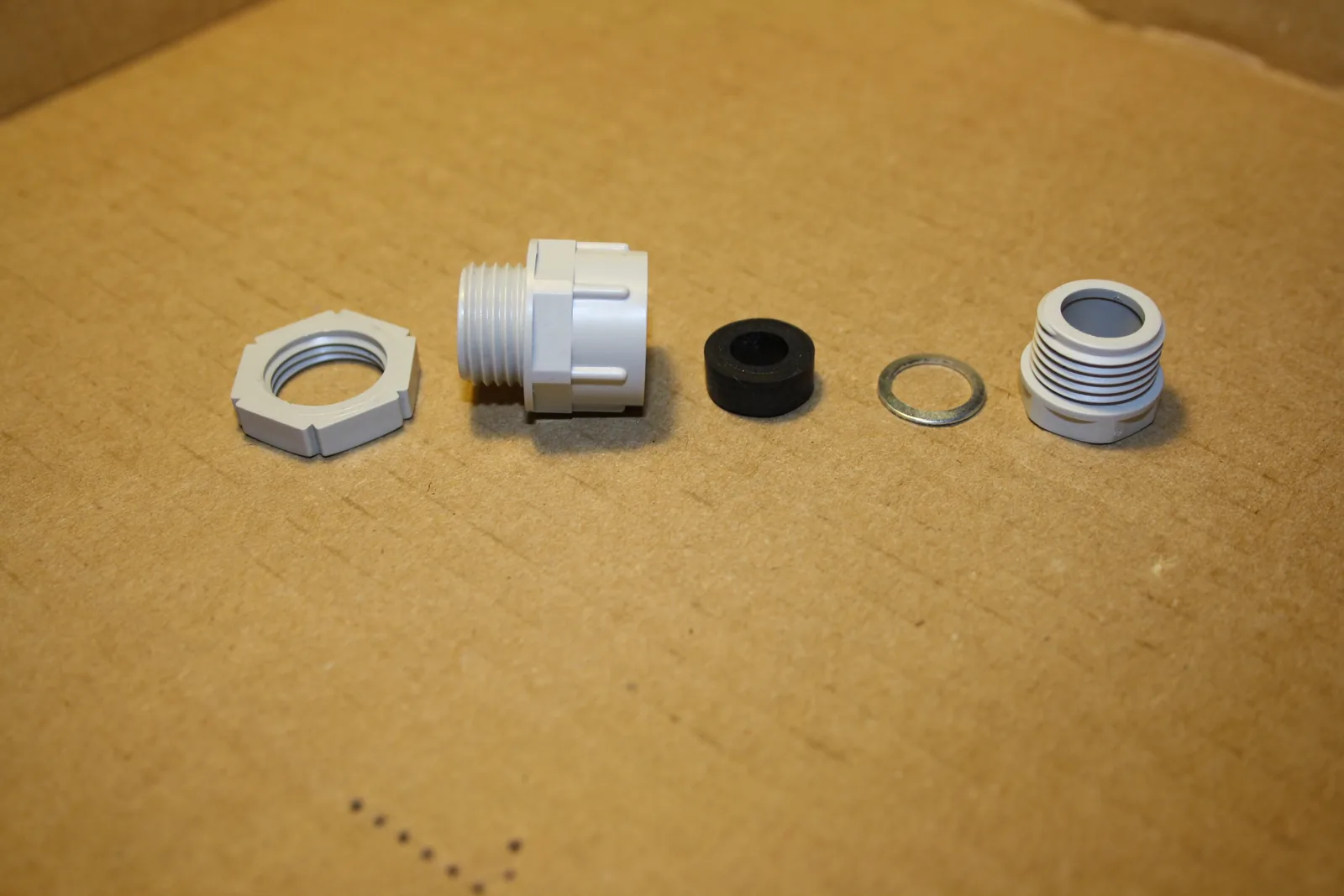
A cable gland is the fixed-cable alternative to a detachable connector. Its panel nut, body, elastomer insert, washer, and compression nut form one mechanical and sealing system; cable diameter and installation determine whether it works. Photo: Leotard, CC0 1.0, via Wikimedia Commons; resized and converted to WebP.
See Decision Examples.
Search terms
38999 jam nut receptacle sealed panel mountM12 panel mount sealed receptaclehermetic connector feedthrough
Specs to check
- IP rating / depth required, and for any IP68 claim the manufacturer-stated depth and duration.
- Panel gasket / O-ring and panel thickness / cutout.
- Coupling and jam-nut torque.
- Internal termination — how the circuit continues inside the box.
- Wire seal sizing and unused-cavity plugs.
Parts people forget
- The panel gasket / O-ring.
- A cap for the unmated exterior connector.
- Correct wire-seal sizing and sealing plugs for unused cavities.
See What People Forget.
Common traps
- Confusing IP67 with IP68 (IP67 ≈ 1 m / 30 min; IP68 = the manufacturer's stated depth/duration).
- Using a standard IP67 part where there is real pressure.
- Treating RTV as "sealing" instead of a rated gasket.
- No unmated cap; undersized wire seal defeating the whole connector's seal.
Questions to ask a vendor/FAE
- Is the IP rating stated for the mated assembly, the unmated/capped connector, and the panel interface?
- For IP68, what exact depth and duration?
- What panel thickness range and cutout does the jam-nut/flange support?
- What gasket/O-ring and torque are specified?
Example documentation bundle
- A selection table row with the sealing target.
- A source-controlled pinout and the internal termination plan.
- A cable drawing and ICD entry recording IP target, panel thickness, gasket, and torque.
Related: Decision Examples · Connector Anatomy §5.5–5.6.