Pick a connector for rugged Ethernet
It's ordinary Ethernet until the cable leaves the clean cabinet. Then the latch, seal, shield path, cable category, bend life, and technician-proofing all become part of the link—not accessories you can bolt on later.
Use this when
- You are carrying Ethernet outdoors, on a moving machine, or through a dirty/wet area.
- You need sealing, a positive latch, and a defined cable-assembly rating.
Avoid this when
- The link stays inside a clean, protected cabinet — a standard RJ45 patch lead may be fine.
- The interface isn't actually Ethernet (fieldbus/CAN belongs on an industrial sensor-style A-coded connector).
Families to start with
- M12 D-coded — commonly used for 10/100BASE-TX industrial Ethernet. Not obsolete; the right choice at 10/100.
- M12 X-coded — 8-pin, shielded; used for GbE/10G-class industrial Ethernet.
- Sealed / rugged RJ45 — only where it is genuinely protected and the connector system is rated for it.
- On the horizon: the compact ix Industrial interface (IEC 61076-3-124) and Single Pair Ethernet connectors (IEC 63171 family) are growing in new industrial equipment — verify ecosystem maturity, cordset availability, and your fleet's tooling before adopting either.
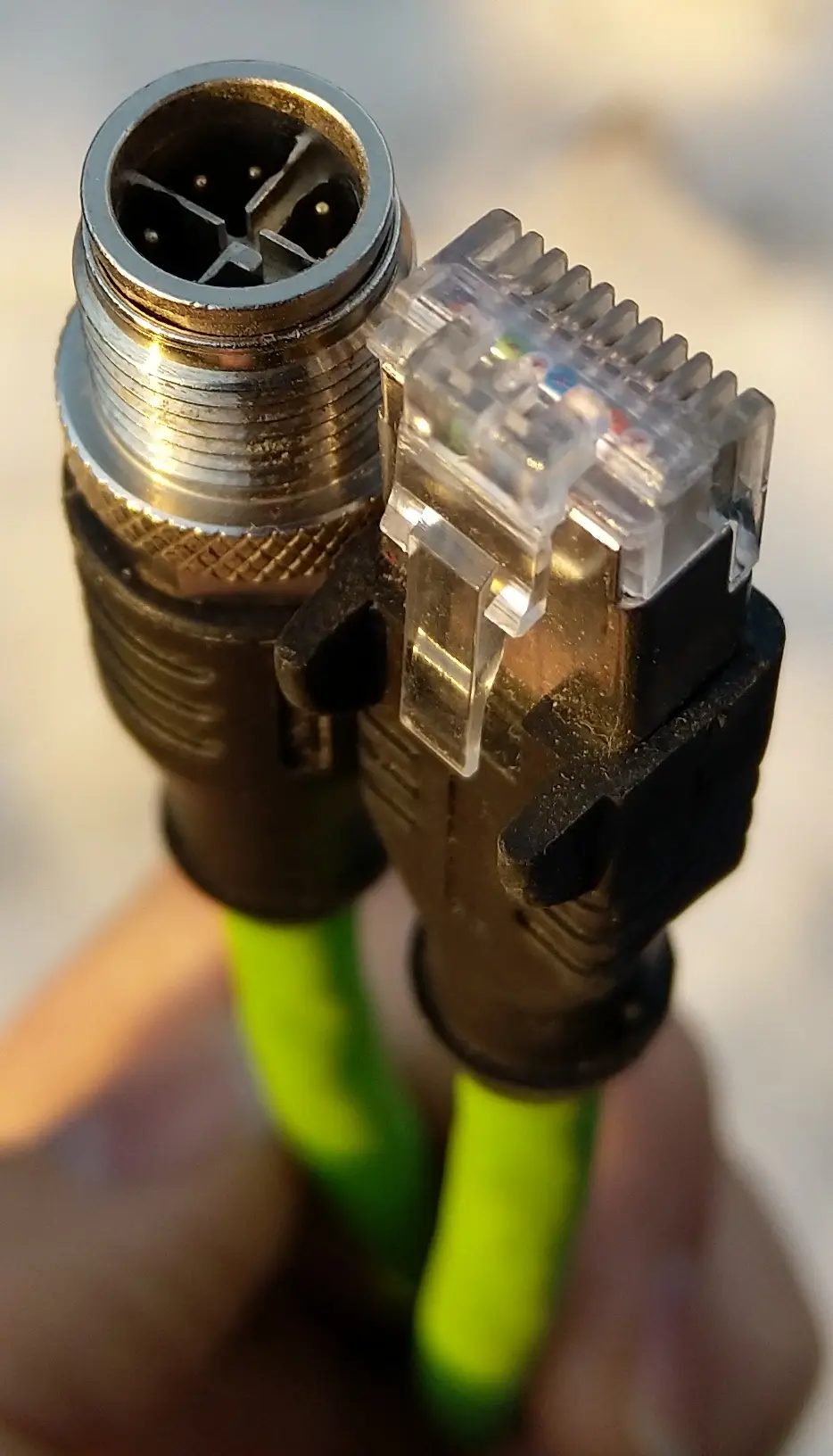
The same cable, two worlds: M12 X-coded (left — note the X-shaped shield cross separating the four pairs) versus a standard 8P8C/RJ45 plug. Photo: Anordal, CC BY-SA 4.0, via Wikimedia Commons.
See the M12 deep dive for the D-coded vs. X-coded distinction.
Search terms
M12 X-coded shielded Ethernet panel mount sealedM12 D-coded 10/100 Ethernet connectorrugged RJ45 sealed panel mount Ethernet
Specs to check
- Data rate vs. coding — D-coded for 10/100, X-coded for gigabit-class. Match the connector to the rate you actually run.
- Cable category and shielding — the connector and the cable assembly both have to support the rate.
- Sealing of the complete mated assembly, and latch protection.
- The overall connector/cable-assembly rating, not just the connector in isolation.
Parts people forget
- Shielded cable matched to the connector, and the shell/shield bond.
- The mating cordset and a cap for the unmated side.
See What People Forget.
Common traps
- Using D-coded for GbE (D-coded is 10/100 — use X-coded for gigabit-class).
- Running unshielded cable on an X-coded link, or terminating with no shell bond.
- Putting a consumer RJ45 outdoors and calling it rugged.
Questions to ask a vendor/FAE
- Is this connector and cable assembly rated for my data rate (10/100 vs. GbE/10G)?
- What cable category and shielding are required?
- Is the IP rating stated for the mated assembly, and is the unmated side sealed only when capped?
- How is the shield/shell bonded through the connector?
Example documentation bundle
- A selection table row capturing the data rate and coding decision.
- A source-controlled pinout (including shield assignment).
- A cable drawing and ICD entry.
Related: Decision Examples · M12 deep dive.