Pick a connector for a compact high-reliability internal interface
Use this path when you need a lot of reliable contacts in very little space and the connector can live inside protected hardware. Micro-D buys density and low weight by asking for careful handling, specialized tooling, and a service model that doesn't involve muddy gloves.
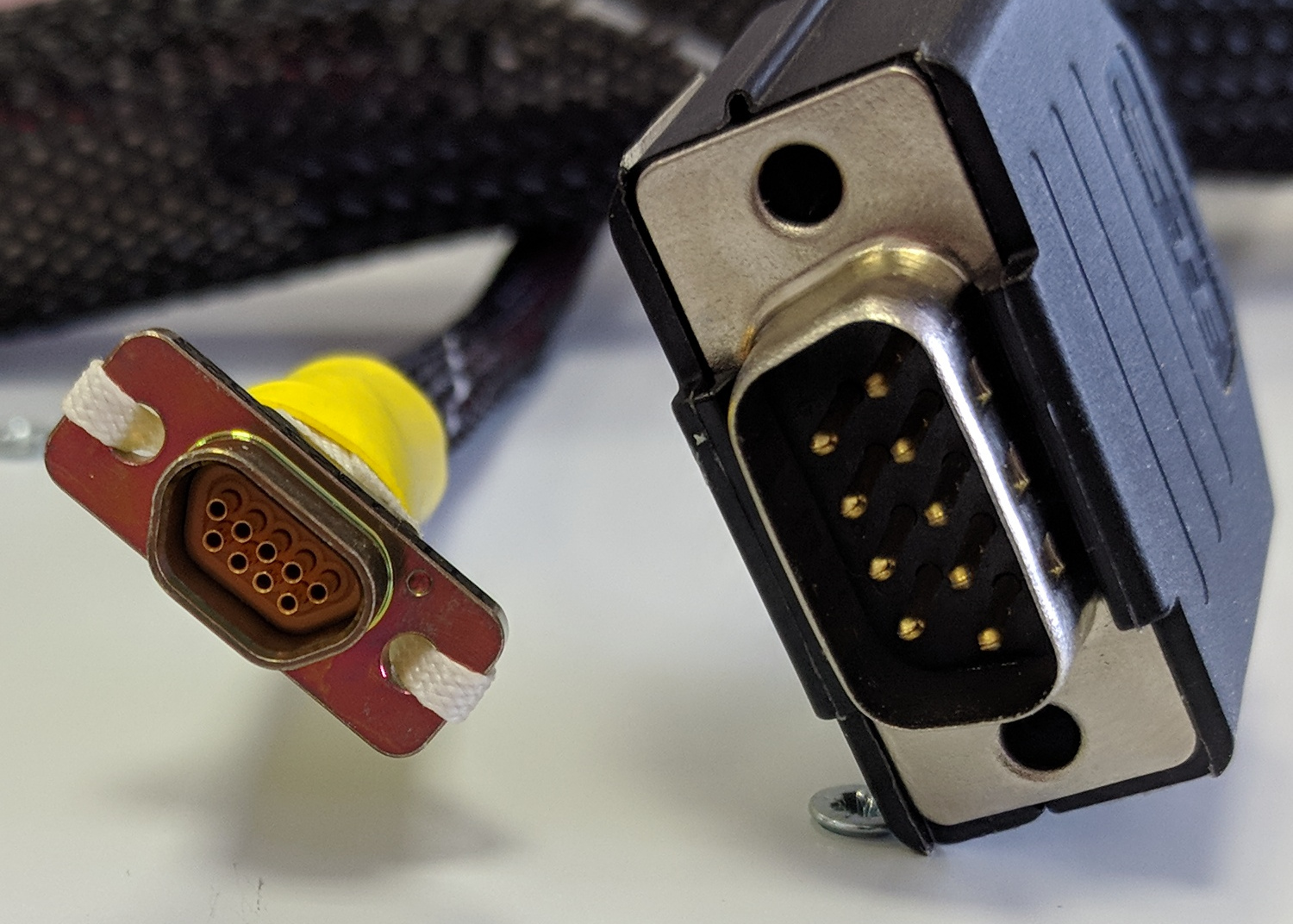
Micro-D beside a standard DE-9 D-sub. Both use the D-shaped shell concept, but the Micro-D's fine-pitch interface buys density at the cost of more delicate handling and assembly. Photo: Andree.sk, CC BY-SA 4.0, via Wikimedia Commons.
Use this when
- The interface lives inside an enclosure or protected assembly and space/weight are constrained.
- You need high density and high reliability — space/aero-style electronics, compact payloads, instrument internals.
- Signals dominate; currents are modest.
Avoid this when
- The connector will be mated/demated in dirty, wet, or field-service conditions — Micro-D is an internal/protected family, not a dirty field-service one (§3).
- You need real current — per-contact capability in this class is low; go to a larger family or dedicated power contacts (high-current DC path).
- A cheaper, bigger connector would do — the density buys cost, delicacy, and assembly complexity you shouldn't pay for without a reason.
Families to start with
- Micro-D (MIL-DTL-83513) — fine pitch (contacts on .050 in / 1.27 mm centers), lightweight, rugged, high-density; the family-level figures (≈3 A-class per contact, sea-level voltage rating) and their source live in §3 Standards and Families.1
- Nano-D (MIL-DTL-32139) — Micro-D's even-finer-pitch sibling for extreme miniaturization: the same handling and assembly discipline, more so. This guide quotes no figures for it — size strictly against the exact spec and part datasheet.
- MIL-grade D-sub (MIL-DTL-24308) where you have the panel space and want cheaper, more forgiving hardware — see the comparison in §3.
- For an occasional-access programming/service flavor of this problem, see the debug / service port path — Micro-D appears there too.
See Decision Examples.
Search terms
MIL-DTL-83513 Micro-D connector catalogmicro-d insert arrangement drawingmicro-d backshell strain relief
Specs to check
- Current per contact vs. your actual loads — this is a signal-class family; check every loaded contact against the exact part's datasheet, not the family figure.
- Voltage rating at your altitude — the family figure cited in §3 is a sea-level rating; verify the exact part and condition.
- Temperature range for the exact part and termination style.
- Contact arrangement — exact arrangements vary by product; pull the manufacturer's drawing (§3).
- Termination and tooling — what the assembly process requires, who performs it, and to which workmanship spec.
- Mounting and keying — board vs. panel vs. cable-to-cable, and how adjacent identical connectors are told apart.
- Qualification — if the program requires qualified parts, verify the exact part number's QPL status; "mil-style" is not qualification.
Parts people forget
- Backshell / strain relief for the cable version — fine-gauge wire bundles need it most.
- The mating half's exact arrangement and gender — verify both halves, not just yours.
- Savers / caps for connectors that see repeated bench mating during development.
- The assembly/tooling budget — the connector is only part of the cost.
See What People Forget.
Common traps
- Treating Micro-D as a rugged external connector because it is "mil-spec" — the spec covers a compact high-reliability family, not dirty field service (§3).
- Running power through a density-optimized signal connector.
- Ignoring assembly complexity until production — delicate, fine-pitch hardware punishes improvised processes.
- Choosing it where a standard D-sub or a small rectangular family would do the job for less.
Questions to ask a vendor/FAE
- What termination styles and tooling does this arrangement require, and what does the application/assembly spec say?
- What are the exact per-contact current and voltage ratings for this part, at my temperature and altitude?
- What keying/polarization options exist for several identical connectors side by side?
- What is the QPL status of this exact part number, if qualification matters on my program?
Example documentation bundle
- A comparison matrix row against a MIL-grade D-sub and one rectangular alternative.
- A source-controlled pinout and an ICD entry recording arrangement, keying, and the assembly spec.
- A cable drawing if it's the cable version — including strain relief and backshell.
Related: §3 Standards and Families · Debug / service port · What People Forget.