Pick a connector for high-current DC power
Once you're feeding motors, batteries, heaters, or a PDU, pin count stops being the interesting part. Current, heat rise, fault energy, and touch safety run the decision. This is not the place to round up from a catalog headline and hope the enclosure stays cool.
A connector is not load-break, hot-plug, touch-safe, or safe to mate/unmate while energized unless the datasheet or governing standard explicitly says so. Many connectors are rated for current only when fully mated and are not intended to interrupt load current.
For high-energy systems — batteries, motor controllers, heaters, PDUs — document fuse protection, inrush/precharge behavior, touch safety, available fault current, and whether mating/unmating is permitted under power.
Use this when
- You are moving real DC power and the current, not the pin count, is the hard constraint.
- Heat rise, derating, and touch safety matter.
Avoid this when
- You are mixing low-level signals into the same insert without an isolation plan — segregate them, or use a hybrid arrangement designed for it.
- The load is small enough that a sensor-class connector already covers it.
Families to start with
- Anderson SB for battery/robot power quick-disconnects — great current density, but unsealed, unshielded, and genderless; add a boot or choose a sealed family for external/environmental interfaces. (The lighter-duty Powerpole line pictured below shares the genderless workflow — the hobby track's Powerpole deep dive covers that system, its family ladder, and its orientation discipline.)
- Industrial rectangular / Han-style power inserts.
- High-current circular connectors.
- Sealed automotive power — DEUTSCH DTP (~25 A contacts) and single-cavity DTHD (~25–100 A) class parts for budget sealed power runs. See the DEUTSCH deep dive.
- MC4-style PV connectors — the solar-string standard, common on solar-charged robots and carts too. Touch-safe and keyed, but emphatically not load-break (PV DC arcs — de-energize before disconnect), and manufacturers warn against mixing brands: use matched pairs from one maker and treat any "MC4-compatible" cross-mating claim as unverified (vendor mixing is a recorded design decision, never a procurement improvisation).
- MIL-DTL-38999 size 12 only where the derating supports the load, or size 8 / larger and dedicated power contacts (e.g. HCP/RADSOK) for higher current.
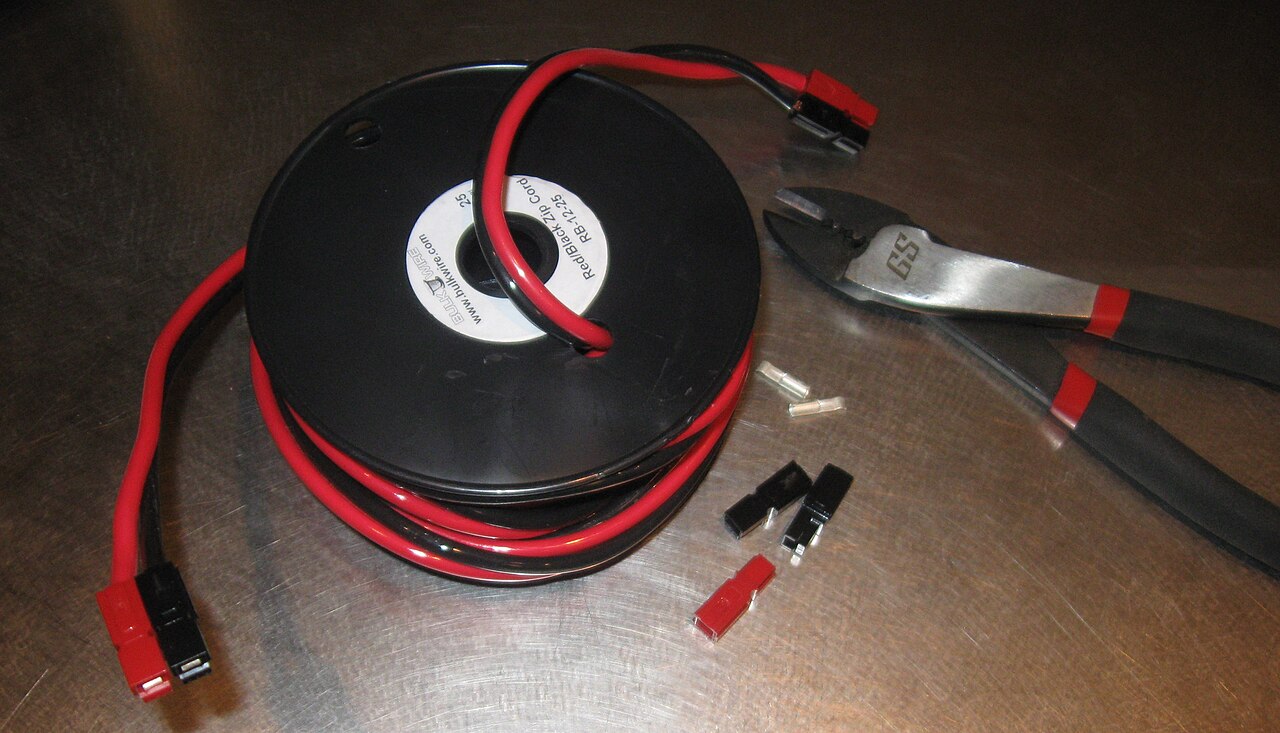
Anderson Powerpole-style housings, loose contacts, wire, and the crimper — the genderless quick-disconnect workflow in one frame. Photo: 4dtext, CC BY-SA 3.0, via Wikimedia Commons.
See Quick-Reference A3 and Decision Examples.
Search terms
Anderson SB power connectorHan power module insert high current38999 size 8 power contact
Specs to check
- Contact current rating at temperature, bundle-derated per the manufacturer's derating curve — current is never one number (see Selection Workflow §2).
- Wire gauge, number of loaded contacts, ambient temperature, heat rise, and duty cycle.
- Touch safety on the energized side (recessed sockets / touch-safe contacts), and whether the connector is touch-safe when unmated.
- Load-break / hot-plug / mate-under-power status — yes / no / explicitly prohibited / not specified — from the datasheet, never assumed.
- Fuse/overcurrent protection, available fault current, and inrush/precharge behavior for the circuit the connector lives in.
Parts people forget
- Actually pulling the derating curve for a fully-loaded connector.
- Touch-safe / recessed contacts on the energized/source side.
- The correct contact size and crimp tooling.
See What People Forget.
Common traps
- Assuming a power connector can interrupt load current. Most are rated for current only when fully mated; opening one under load can arc, weld or destroy the contacts, and injure the technician. If service requires disconnect under power, that capability must come from the exact datasheet — or from an upstream disconnect/contactor instead.
- Paralleling contacts to reach a current unless the manufacturer/application explicitly supports it and the design is reviewed.
- Undersizing the contact, or judging safe current from contact size alone.
- Treating a hobby power connector (XT60/90) as an IP-rated professional solution.
Questions to ask a vendor/FAE
- What is the derating curve for a fully-loaded connector at my ambient temperature?
- What is the continuous current for this exact contact P/N and wire gauge?
- Are dedicated power contacts (e.g. HCP/RADSOK) available, and is paralleling supported for this product?
- What is the touch-safety / finger-proofing story on the energized side, mated and unmated?
- Is mating/unmating under power permitted for this connector? Is any load-break or hot-plug capability stated, and at what voltage/current?
Example documentation bundle
- A selection table row that records the derating assumption.
- A source-controlled pinout marking source/load direction.
- A cable drawing and ICD entry capturing current, wire gauge, torque, and the energized-work statement: load-break/hot-plug status, mate/unmate-under-power permission, touch safety, fusing, fault current, and inrush/precharge — plus any required warning label or service procedure.
Related: Decision Examples · Selection Workflow.