7. MIL-DTL-38999 Deep Dive
If you work around aerospace or defense hardware, you'll meet 38999 sooner or later. It packs sealing, high contact density, rugged coupling, EMI backshells, removable crimp contacts, alternate keying, and a mature multi-supplier ecosystem into one family. It also packs enough part-number fields and accessory choices to punish anyone who orders from the photo.
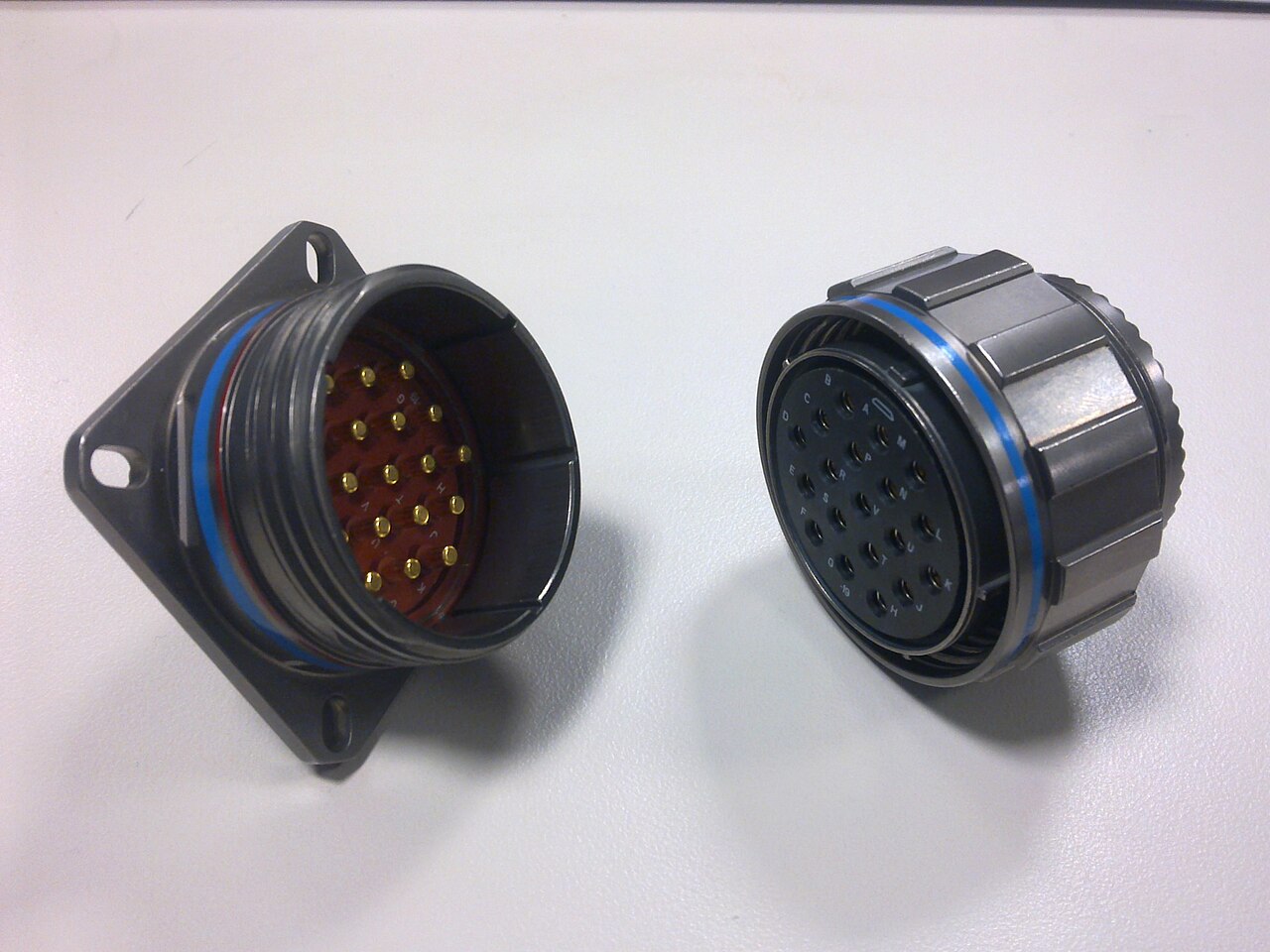
A 38999-style pair: square-flange receptacle (left) and plug with coupling nut (right) — note the recessed gold crimp contacts and witness bands. Photo: Abaillieul, CC BY-SA 3.0, via Wikimedia Commons.
For a scenario walkthrough, see the Defense / rugged external I/O decision path. This page is the detail behind that choice.
7.1 What a full 38999 interface includes
Panel receptacle + cable plug + insert arrangement + pin/socket selection + crimp contacts + backshell + shield termination + strain relief + cable boot/gland + dust caps + gasket/O-ring + pinout drawing + torque and assembly procedure.
Whether contacts are supplied with the connector or must be ordered separately depends on the exact part number and its suffix — some part numbers include contacts, while "less-contact" versions ship the shell and insert without them. Verify for your specific part number whether contacts are included, omitted, or ordered as a separate line item, and order the matching AS39029 contacts and crimp tooling accordingly.
7.2 Series — practical distinctions
| Series | Coupling | Practical meaning |
|---|---|---|
| Series I | Bayonet | Rugged environmental circular; common historically in aero/defense |
| Series II | Bayonet, low-profile / space-saving | Lower-height version where space/height matters |
| Series III | Threaded (Tri-Start triple-start thread, self-locking / anti-decoupling features)1 | Often the default choice for new harsh-environment defense/aerospace designs unless size, mating speed, legacy compatibility, customer requirements, or program requirements drive another series. Scoop-proof (the outer shell engages before the pins, so a misaligned plug can't scoop across and bend them). Requires correct coupling engagement and manufacturer-specified torque where applicable; do not rely on casual finger-tight assembly in vibration environments. |
| Series IV | Breech-lock | Less common, specialized use |

What you're looking at on the bench: square-flange receptacle, knurled coupling nut, Tri-Start thread — and the ID cues that separate Series III from the bayonet series.
7.3 Shell sizes
Common 38999 Series I/III shell sizes are odd-numbered: 9, 11, 13, 15, 17, 19, 21, 23, 25 (Series II uses its own even-numbered scheme, 8–24 — decode from the catalog). Larger shell = more room for contacts, larger contacts, or hybrid layouts — at the cost of weight, panel space, and money. The typical contact range below is a rough orientation aid, not a selection rule. Actual contact count and contact sizes are defined by the insert arrangement drawing.1
| Shell size | Approx OD | Typical contact range (orientation only) | Notes |
|---|---|---|---|
| 09 | ~22 mm | 4–8 | Small payloads, power-only |
| 11 | ~25 mm | 6–12 | Small sensor/power interfaces |
| 13 | ~29 mm | 10–20 | Very common general-purpose |
| 15 | ~32 mm | 12–30 | Mid-range, widely stocked |
| 17 | ~36 mm | 16–40 | Large harness interface |
| 19 | ~40 mm | 20–50 | High-density data/signal |
| 21 | ~44 mm | 30–60 | Heavy-duty harness |
| 23 / 25 | ~48–52 mm | 50–128 | Max density; manage thermal derating carefully |
Shell-size numbers are designations, not direct millimeter measurements. Approximate ODs are shell-style-dependent — for the Amphenol Series III straight plug, coupling-nut OD runs from ~22 mm (size 9) to ~48 mm (size 25), and receptacle/jam-nut styles are larger. Verify dimensions against the specific manufacturer datasheet.1
7.4 Insert arrangements
The insert arrangement defines contact count, sizes, positions, and any mixed power/signal/coax layout. A pin count alone is insufficient. You must know: are all contacts the same size? Any larger power contacts? Room for spares? Can the wire gauges physically terminate? Are signals logically separated? Is the arrangement common and available? Always pull the arrangement drawing.
7.5 Contact sizes and current
MIL-DTL-38999 uses AS39029 (formerly M39029) crimp contacts in sizes such as 22D, 20, 16, 12, and 8, plus size 23 in high-density variants and special coax/twinax/quadrax/fiber contacts. The values below are contact-resistance test currents and matching wire size from a manufacturer contact-performance spec — they are useful for relative sizing, not a guaranteed continuous-current rating for your application. This test current (for the contact-resistance check) is a different, lower parameter than the contact's free-air current-carrying rating — for size 16 that's roughly 13 A carrying vs. the 10 A test value. Neither is what you design to directly: the allowable current comes off the manufacturer's derating curve for your loaded-contact count and temperature.2
| Contact size | Matching wire (AWG) | Spec test current (example) | Typical role |
|---|---|---|---|
| 22D | 22 | 3 A | Logic signals, low-current analog, discrete I/O, high-density |
| 20 | 20 | 5 A | General signal / light power |
| 16 | 16 | 10 A | Moderate power |
| 12 | 12 | 17 A | Higher-current power |
| 8 and larger | per catalog | higher (power contacts) | High-current power; also coax/twinax in size 8 |
| 23 (HD) | per catalog | lower than 22D | High-density signal only; verify by exact P/N |

Approximate relative sizes, for orientation only — dimensions and ratings come from the AS39029 contact drawing and the derating curve.
These are example test values from one manufacturer's contact spec, not a universal continuous rating. Actual allowable current depends on the exact contact P/N, wire gauge, insulation, number of loaded contacts (bundle derating), ambient temperature, and acceptable temperature rise. Always size against the specific manufacturer's derating curve and contact datasheet. Smaller size number = physically larger contact = more current.
7.6 Coax, twinax, and quadrax in a 38999
A single 38999 shell can carry an RF coax contact, a differential pair, 28 V power, and discrete signals simultaneously using special contacts in a mixed insert arrangement. This is a major reason hybrid 38999 connectors exist. Note that ordinary CAN often uses a shielded twisted pair carried on ordinary signal contacts; twinax/quadrax/special contacts are used where controlled impedance, shielding, or high-speed/EMI performance requires them. If you have one RF line going to a sealed payload alongside power and control, you may not need a separate coax bulkhead connector — a coax contact in the existing 38999 may do it. Verify the contact's frequency rating and impedance against the arrangement.
7.7 Service classes and keying
Service class controls shell material, plating/finish, corrosion resistance, conductivity, and environmental capability (aluminum with cadmium/nickel, stainless, composite, zinc-nickel alternatives, firewall/hermetic, etc.). Verify against the manufacturer catalog and applicable slash sheet.
D38999 Series III uses rotational keying (polarization) with positions commonly designated N, A, B, C, D, and E — N being normal1 — giving up to six clockings per shell size. Both halves must share the same position to mate; even identical connectors won't mate if keys differ. Use alternate keying when several same-shell-size connectors sit on one panel, when wrong mating could damage equipment, or when power and signal connectors could be confused. Document keying in the ICD — don't rely on technician memory. Verify the exact polarization options against the manufacturer's catalog for the specific connector.

The master keyway stays fixed; the minor keyways rotate per position. Angles shown are the shell-size 17/19 receptacle BSC values from the manufacturer's master-key table1 — they differ by shell size, so decode from the catalog.
7.8 Decoding a part number (worked example)
A genuine MIL-DTL-38999 Series III part number uses the D38999/... base specification. Example: D38999/26WE26PN (a Series III straight plug in this manufacturer's decoder family).1
| Field | Value | Meaning |
|---|---|---|
| D38999/26 | /26 | For this D38999 Series III decoder family, /26 indicates a straight plug. Verify other shell-style numbers against the specific manufacturer catalog. |
| W | W | Finish/material class. In Amphenol's decoder, W = corrosion-resistant olive-drab cadmium-plated aluminum. Finish letters vary by manufacturer. |
| E | E | Shell-size letter. The shell-size letter must be mapped through the catalog. For this example, E maps to shell size 17. |
| 26 | 26 | Insert arrangement code for that shell size. Read with the shell size, the full designation is 17-26 (shell size 17, arrangement 26). |
| P | P | Contact type — P = pin, S = socket |
| N | N | Polarization/keying position N = normal (positions are N, A, B, C, D, E) |
Read it as linked fields: the letter (E) gives the shell size (17), and the trailing number (26) is the insert arrangement within that shell size. The 26 alone is not the full insert arrangement — the full designation is 17-26. The same arrangement number means different things in different shell sizes, so always pair them.
D38999 part-number schemas vary by manufacturer (Amphenol, Glenair, Souriau, ITT Cannon, TE, Eaton). Finish letters, available arrangements, and accessory codes are not identical across vendors. Always decode against the specific manufacturer's catalog/decoder, and verify against the QPL when qualification matters. "Mil-spec style," "MIL-compatible," or "built to a military standard" does not automatically mean the exact part is qualified — when qualification matters, verify the exact manufacturer, part number, slash sheet, and status in the applicable QPD/QPL or program-approved source. A conforming part number from two vendors is not automatically interchangeable — match series, shell size, insert arrangement, contact type, finish, and keying.
7.9 Common 38999 beginner mistakes
| Mistake | Consequence |
|---|---|
| Not checking whether contacts are included | Some part numbers ship without contacts ("less-contact" versions); verify and order contacts + crimp tooling if needed |
| Wrong crimp tool / die | Crimp passes visual, fails in vibration |
| Omitting the backshell | No strain relief, no rear seal, no shield termination |
| Not engaging/torquing the coupling correctly | Fretting and decoupling under vibration; finger-tight ≠ engaged |
| Exposed live pins on the energized side | Shock/short risk. Put recessed sockets or touch-safe contacts on the energized/source side; verify gender against the mating half |
| Wrong pin/socket gender vs. the mate | Won't mate, or mates with damage; gender is independent of plug/receptacle — verify both halves |
| Same key on different pinouts | Eventual mis-mate |
| No alternate keying on similar connectors | Cross-mating of adjacent connectors |
| No dust caps | Corrosion/pin damage on unmated ports |
| Undersized wire in wire seal | Cavity leaks; sealing defeated |
| Assuming all 38999s intermate | Series, keying, and insert must all match |
| No torque/assembly procedure documented | Sealing and anti-vibration features compromised in build |