3. Connector Standards and Families
Use this page as a map, not release authority. Standards get revised, manufacturers encode part numbers differently, and catalog ratings leave out the conditions that matter. If this guide disagrees with the current standard or datasheet, the source document wins.
Treat every number below as a screening value. A released design still needs the exact datasheet, derating curve, application specification, and program or customer requirement. For orientation: MIL-DTL-38999 covers miniature high-density environmental circular connectors with removable crimp or hermetic solder contacts. M12 connectors live in the IEC 61076-2-x family—for example, -2-101 for A/B/D codings, -2-109 for X-coded, and -2-111 for power codings. The details and sources live on the 38999 and M12 deep dives.
3.1 At-a-glance family comparison
Part A — application, strengths, weaknesses
| Family | Used for | Strengths | Weaknesses |
|---|---|---|---|
| MIL-DTL-38999 | Aero/defense rugged external I/O | Sealing, density, keying, EMI backshell ecosystem, crimp contacts | Expensive, part-number traps, tooling-heavy |
| MIL-DTL-26482 | Rugged circular mil/industrial I/O | Smaller/cheaper than 38999, fast bayonet, common; Series 1/2 variants vary by P/N | Less dense, fewer modern high-speed options than 38999 |
| M12 | Industrial sensors, Ethernet, IO-Link, CAN | Standard ecosystem, molded cables, IP-rated options, easy sourcing | Coding/pinout confusion, limited pins/current |
| M8 | Compact sensors, small actuators | Small, common sensor connector | Less current, fewer pins, smaller cable support |
| D-sub / MIL-DTL-24308 | Rack/panel, test, legacy serial/control | Cheap, common, many accessories, good density | Standard versions non-environmental; screws can loosen |
| Micro-D / MIL-DTL-83513 | Space/aero, compact high-reliability | High density, light, rugged, fine pitch | Expensive, delicate, assembly complexity, lower current |
| Terminal blocks | Control panels, DIN-rail, service wiring | Easy troubleshooting, modular, field-friendly | Fixed types are not quick-disconnects; need enclosure |
| Board-to-board stacking | Daughtercards, mezzanine modules, backplanes | Matched-height pairs, high density, no harness to build | Low cycle counts; needs mechanical support; tolerance-stack sensitive |
| M23-class servo circulars | Servo motor power + encoder feedback | Multi-vendor ecosystem, shielded, IP67-class mated, quick-lock options | The drive ecosystem's cordsets usually beat a custom build; cross-vendor intermating is a claim to verify |
| Industrial rectangular / Han-style | Machinery, removable modules, mixed power/signal/data | Modular inserts, high current, robust housings | Large, many options; qualification varies |
| RF / coax | Antennas, RF, GPS, radar, timing | Controlled impedance, shielding, frequency-rated | Must match cable/impedance/torque/frequency |
Part B — cost, when to consider, when to prefer an alternative
| Family | Cost | Consider when | Prefer an alternative when |
|---|---|---|---|
| MIL-DTL-38999 | High | Harsh environment, vibration, defense/aero, configuration control | Low-cost commercial gear, casual prototypes |
| MIL-DTL-26482 | Med-High | Rugged but not extreme; legacy compatibility; moderate pins | Threaded/self-locking coupling, higher density, or the modern defense ecosystem is required |
| M12 | Low-Med | Factory automation, sensors, field I/O | Mil-spec qualification, very high pin count, high power (unless correctly coded) |
| M8 | Low-Med | Small sensors, limited current, tight space | Heavy cable, rugged power, severe vibration without verified support |
| D-sub / MIL-DTL-24308 | Low-Med | Internal panels, lab gear, legacy interfaces | Wet/dirty external use without a ruggedized variant and strategy |
| Micro-D / MIL-DTL-83513 | High | Space/weight-constrained high-reliability systems | Field-serviceable dirty environments, high current |
| Terminal blocks | Low-Med | Industrial panels, power distribution | External rugged harness disconnects |
| Board-to-board stacking | Low-Med | Rigid parallel/perpendicular board joints inside an assembly | Boards move relative to each other, frequent mating, or an external/sealed interface |
| M23-class servo circulars | Med | Servo/motor power + feedback where the motor's receptacles set the series | Small motors on M12-class ecosystems; terminal-box wiring; mil requirements |
| Industrial rectangular / Han-style | Med-High | Machine sections, removable boxes, mixed interfaces | Small payloads, aero weight-sensitive systems |
| RF / coax | Low-High | Any real RF path | Discrete wiring / uncontrolled impedance |
Two specific clarifications worth internalizing:
- MIL-DTL-24308 D-subs in their standard form are non-environmental, polarized rack-and-panel connectors.1 "Mil-spec" does not by itself mean "rugged outdoor / environmentally sealed" — read what the spec actually covers. Ruggedized/environmental D-sub variants exist and must be selected and verified intentionally. D-subs are perfectly appropriate for protected panels, racks, test gear, legacy interfaces, and internal equipment.
- Micro-D (MIL-DTL-83513) is a fine-pitch (contacts on .050 in / 1.27 mm centers), high-density, lightweight, high-reliability family used where size and weight matter.2 It carries lower current than larger connectors (≈ 3 A per contact) and has more assembly/tooling complexity. Exact contact arrangements vary by product — verify against the catalog. Treat it as an internal / protected high-reliability connector, not a high-current or dirty field-service connector.
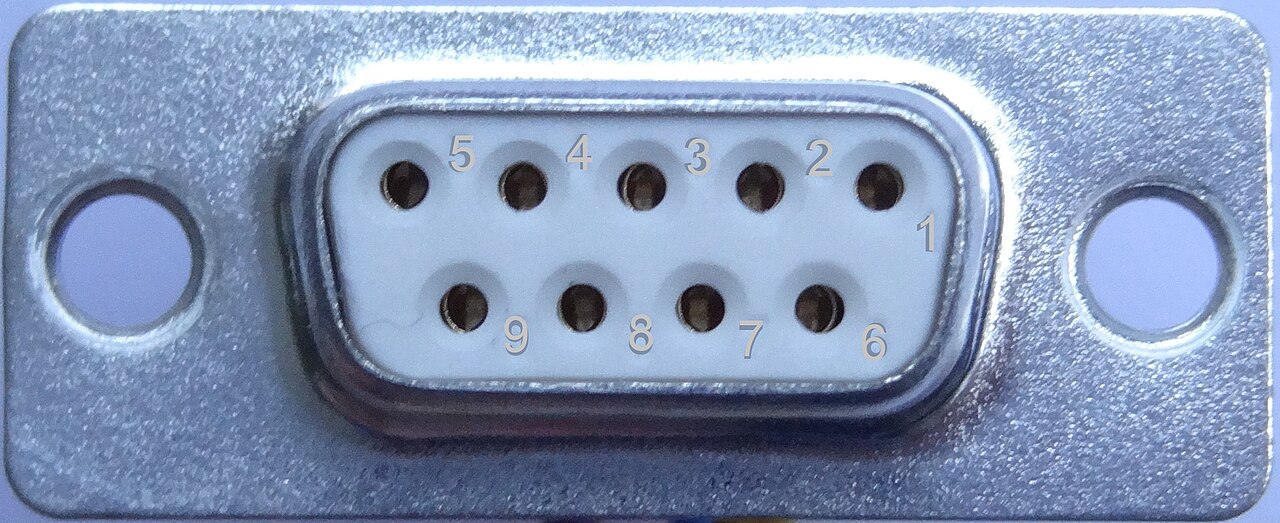
The D-sub everyone has met: a DE-9 female, positions numbered. Polarized trapezoid shell, rack-and-panel — and non-environmental in standard form. Photo: FireEmerald, CC BY-SA 4.0, via Wikimedia Commons.
3.2 Sealed automotive connector families
Between hobby connectors (JST, Dupont) and mil-spec circulars (38999) sits a cost-effective, sealed, crimp-based ecosystem built for vehicles — often the right answer for makers and robotics teams going rugged on a budget. These are wire-to-wire / panel crimp systems; verify the exact series datasheet.
| Family | Typical sealing | Typical current / contact | Notes |
|---|---|---|---|
| Deutsch DTM / DT / DTP | IP683 | ~7.5 A (DTM, size 20) / ~13 A (DT, size 16) / ~25 A (DTP, size 12)3 | Genderless wedgelock housings; ubiquitous in off-road/automotive; hand-crimpable |
| TE AMP Superseal 1.5 / AMPSEAL | IP674 | ~14 A (Superseal 1.5)4 | Compact sealed inline; AMPSEAL for higher pin counts |
| Molex MX150 / MX150L | IP675 | up to ~30–40 A (MX150L, 8–12 AWG)5 | Sealed signal-to-power; industrial/automotive |
| Aptiv (Delphi) Metri-Pack | Sealed & unsealed variants6 | 150 / 280 / 480 / 630 / 800 series — a few A up to tens of A by series (verify)6 | Long-standing automotive terminal system |
| Aptiv (Delphi) Weather-Pack | Sealed — triple-ribbed self-lubricating silicone connector and cavity seals7 | ~20 A max continuous class (verify per terminal/gauge)7 | 1–6-way towers/shrouds; the classic sealed under-hood system; tin-plated crimp terminals |
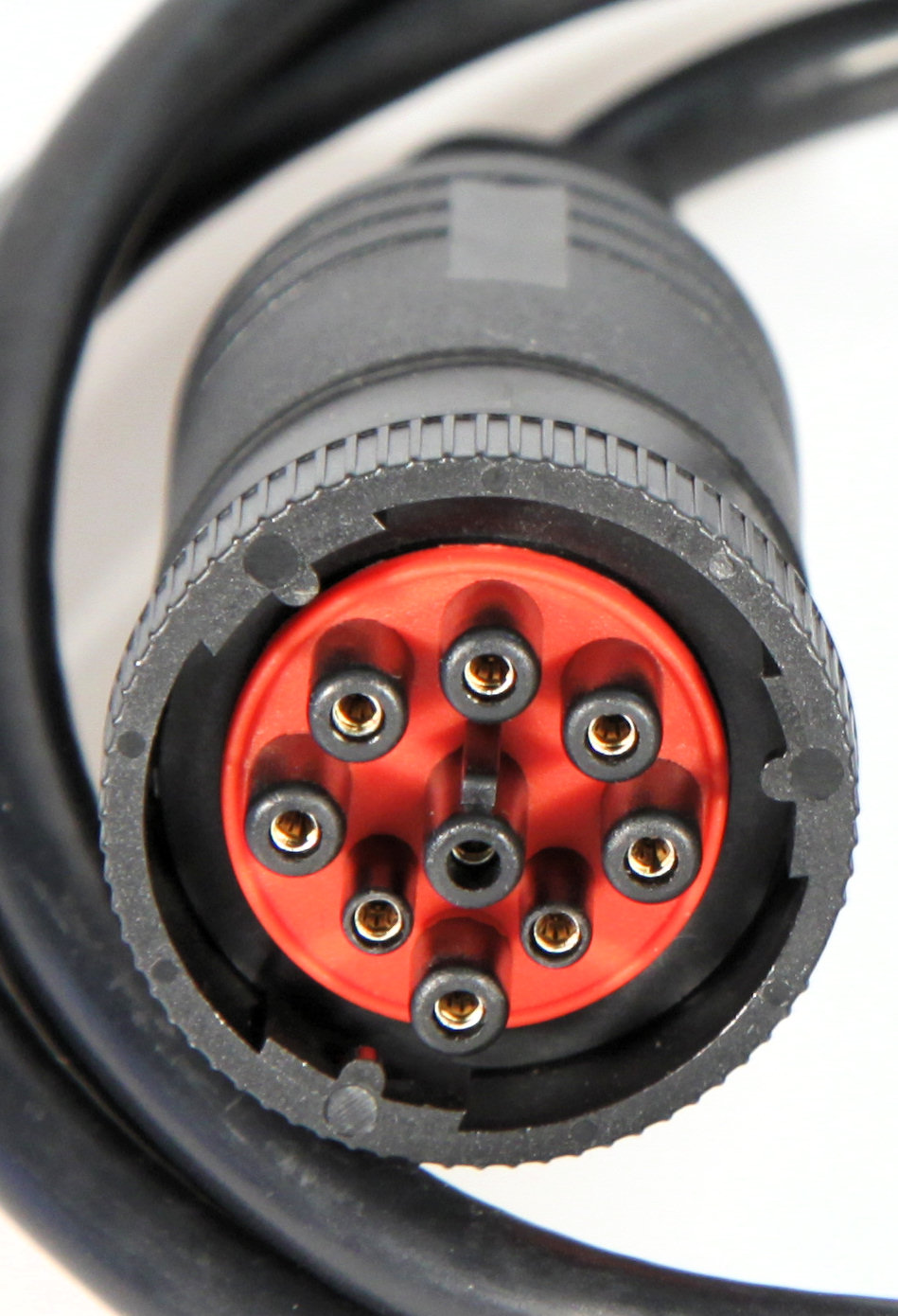
The sealed-automotive look: a Deutsch HD-style 9-pin plug (here a J1939 vehicle-diagnostic connector) — crimp contacts, wire seals, thumb-coupled shell. Photo: Florian Schäffer, CC BY-SA 3.0, via Wikimedia Commons.
Where they win: datasheet-rated sealing (IP67/IP68-class, by family) and vibration performance well beyond hobby connectors, at a fraction of the cost, tooling, and lead time of mil-spec circulars — cheap hand crimp tools, no QPL overhead. They are a strong middle ground for rugged-on-a-budget field wiring; they are not a substitute for MIL-DTL-38999 where qualification, EMI backshells, or extreme environments are required — and "automotive sealed" is not a universal environmental rating. Verify the seal system, wire-seal range, cavity plugs, temperature range, vibration suitability, fluid exposure, and IP test conditions against the family documentation. For the full DEUTSCH range — every size from DTM through DTHD, the HD circulars, and DRC — see the DEUTSCH Deep Dive. Second sources exist in this territory too: Amphenol Sine's AT / ATM / ATP lines are marketed as intermateable equivalents of DEUTSCH DT / DTM / DTP8 — a legitimate sourcing option, but treat cross-vendor interfaces as compatibility claims to verify, never folklore.